


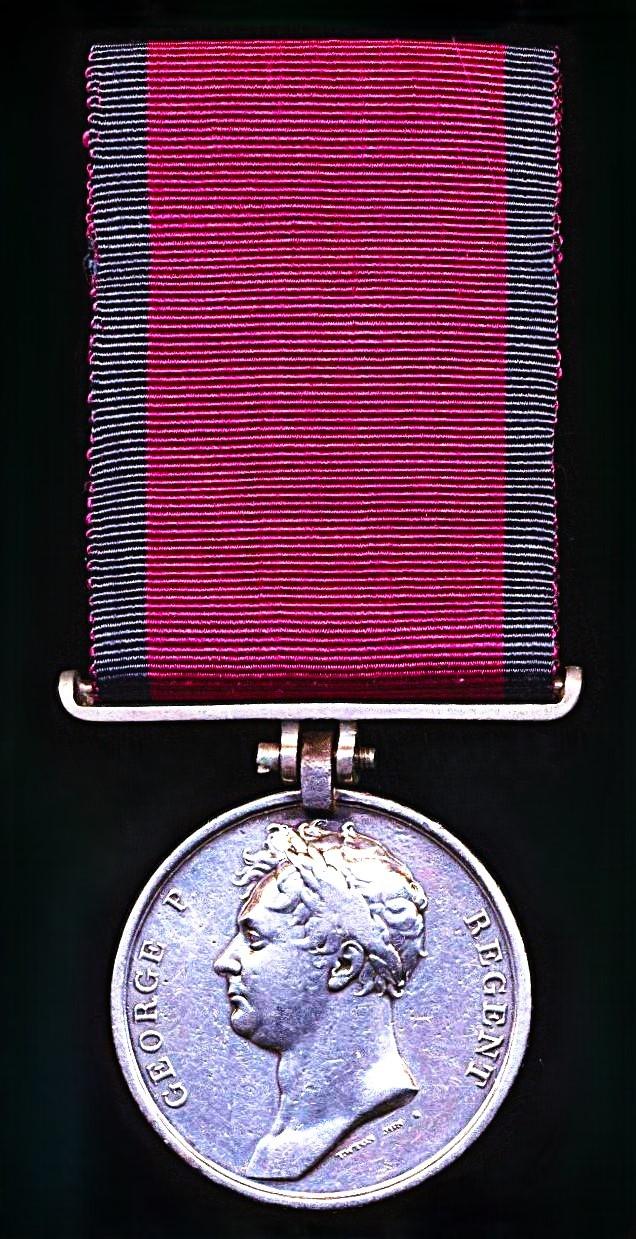
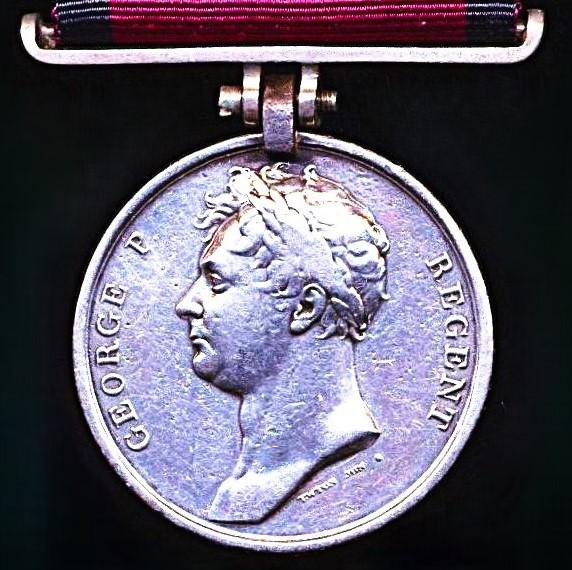
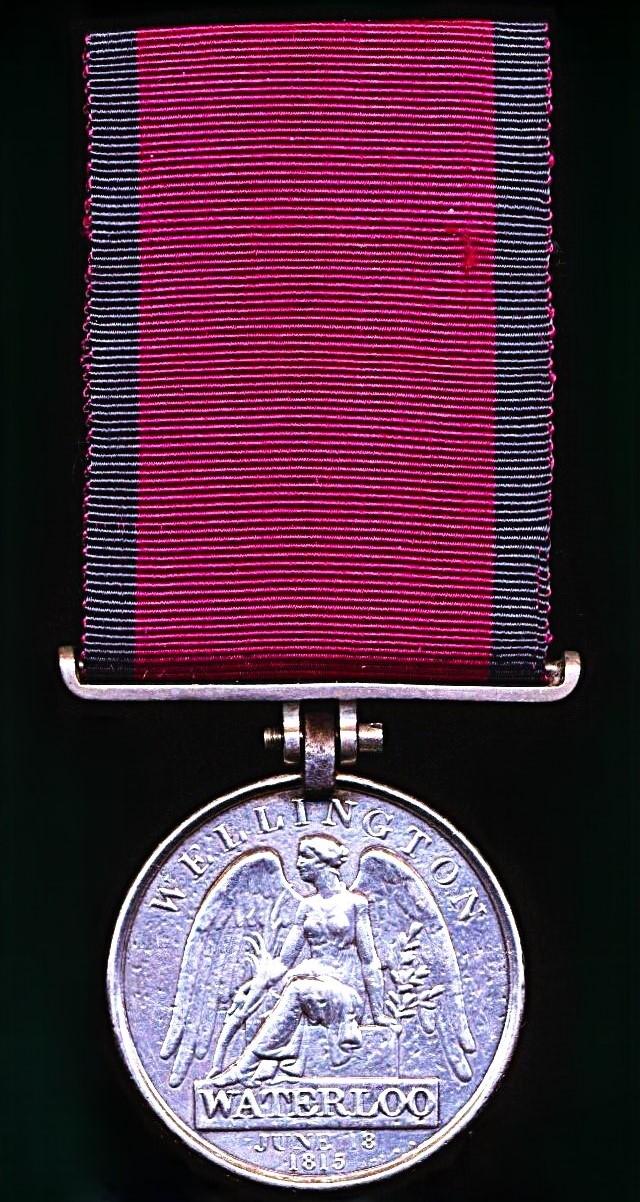

Waterloo Medal 1815 (William Hilliard, 42nd or R.H. Reg. Infantry.)
The recipients surname is recorded variously as Hilliard (sic) when it should be 'Hellard'. The medal named with officially impressed naming exactly as issued, and per the name shown on the recipient's his extant service papers, and as used in the regiment since 1811 and throughout the recipients military service
The medal retaining its original steel clip this fitted with a contemporary replacement hinged straight suspension bar
Medal Verification: William Hilliard's entitlement to the Waterloo Medal is confirmed as entitled per below source:
- Waterloo Medal: The Waterloo Medal Roll (The Naval & Military Press, 1992)
The 'Waterloo Medal Roll' shows that William Hilliard - a unique name in the regiment - served in the Waterloo Campaign in Captain Murdoch McLaine's Company of the 42nd Royal Highland Regiment of Foot - The Black Watch
The recipient never served in the Peninsula Campaign, and there is no one called William Hilliard on the MGS medal rolls of the 42nd Royal Highland Regiment
The Black Watch (42nd Highlanders) suffered significant casualties during the Waterloo Campaign, especially at Quatre Bras (June 16, 1815) where heavy losses left them depleted for the main battle, and at Waterloo (June 18) where they were praised by Wellington and endured further losses. At the start of the campaign the regiment mustered an effective strengh of 556 x 'All-Ranks', of which the casualties incurred by the 42nd at Quatre Bras & Waterloo totalled 337 x 'All- Ranks', comprising:
- Officers: 3 x killed & 21 x wounded
- Other Ranks: 47 x killed & 266 x wounded
1821 Seriously Wounded by Irish rebel 'Ruffians': What the Grande Armee of the Emperor Napoleon failed to do in battle, a cabal of Irish Rebel 'Ruffians' almost succeeded in doing, only 6 years after the Battle of Waterloo, when now Sergeant Hilliard of the 42nd Highlanders, was seriously wounded when set upon by Irish ruffians at Bruree, Co. Limerick, Ireland. The newspaper 'Freemans Journal' of Dublin, issue of 22 December 1822, contained the below following articile pertaining to an incident in Co. Limerick:
Quote,
Friday night, a party of the 42d Highlanders, stationed at Bruree, in this County, were called to quell a riot in a public house; on approaching it, the Serjeant (William Hilliard) followed a man who was pointed to him as the principal in the affray. The Serjeant called on him to surrender, but was met by a blow of a large stone, which felled him to the ground; the ruffian stamped on his body and certainly inevitable death would have followed; but, fortunately, Ensign Clarke and Corporal Whitley came up and secured the man, named Gore, who, with two of his companions, Leary and Murphy, were secured and lodged in jail. In their possession was found, a prayer book, which, it is stated, was used by them in administering illegal oaths, and also a quantity of gun-powder was got in Murphy's pocket.
Unquote.
William Hilliard (sometimes recorded as Hellard) was a native of Ashbrittle, Wellington, Somerset, where he was born circa 1796. By trade a 'Labourer' he joined the British Army at Musselburgh, Midlothian. Scotland, on 22 January 1811, at which time he was just 15 years of age. At enlistment he was posted to the 42nd Royal Highland Regiment - the Black Watch. In total his reckonable service from the age of 18 years (when adult service commenced & including 2 years for the Waterloo Campaign) through to the time he took his final discharge from the British Army on, 10 January 1837, was a total of 24 years & 354 days towards pension
During his many years service, William Hilliard held the rank of Corporal for 8 years & 11 days, and the rank of Sergeant for 8 years & 287 days. The locations of his overseas service (outside of home service in Great Britain and Ireland) was:
- Flanders & France: 7 x months
- Gibraltar, Malta & Corfu: 7 years & 10 months
After retiring form the British Army,William Hilliard, returned to his home-town area, where in the National Census for England 1851, he is shown as 'Hellard' described as an 'Army Pensioner Chelsea' living together with his wife Sarah, an Irish woman (from Co. Typrone, Ireland) living at the parish of West Buckland, Wellington, Somerset. The following National Census of 1861 records William shown as 'Hellard', and described as 'Chelsea Pensioner' living with his Irish wife Sarah, at, 174 Mantle Street, Wellington, Somerset, England. William Hilliard (or Hellard) is recorded to have died at Wellington, Somerset, England sometime during the second quarter of 1865
A most desirable medal to a Black Watch, Sergeant, who having survived the killing fields of 'Flanders' at Waterloo, later almost lost his life to Irish rebel ruffians
The recipients service papers are extant and accessible at The National Archives
Condition: About VF
Code: 25704