


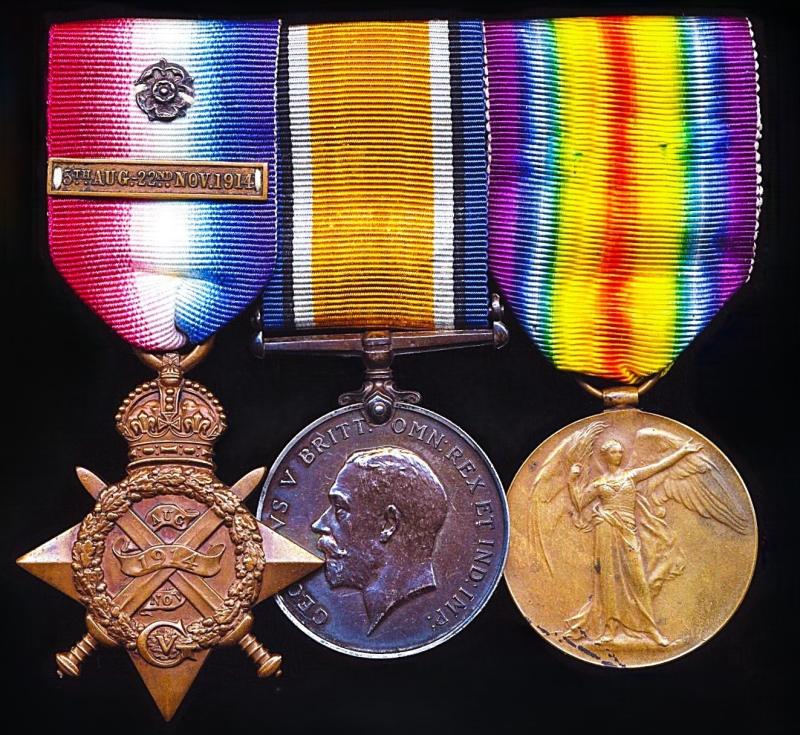
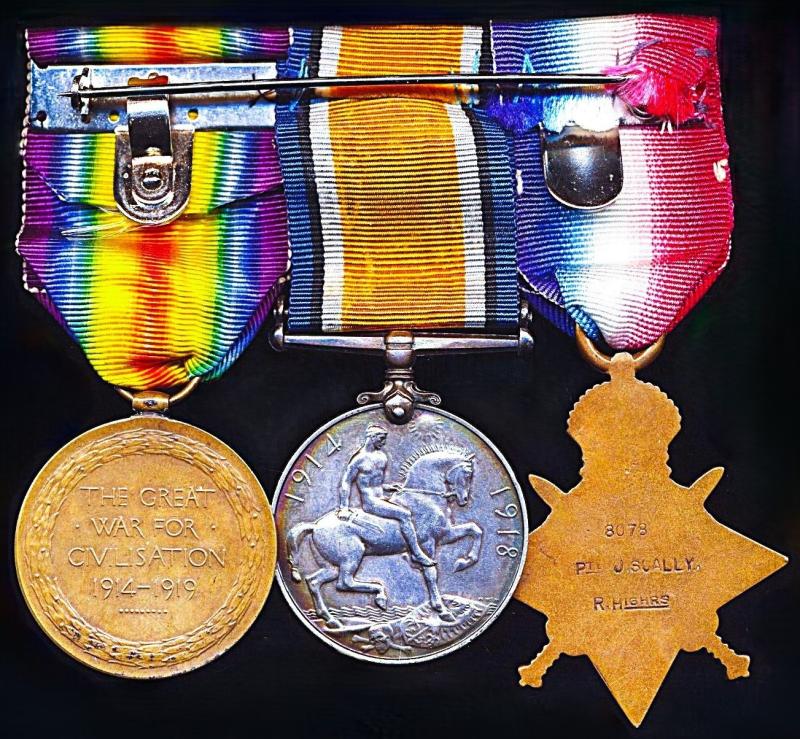
Scot's Wha Hae & 'True-Grit' Personified' - a Mons 1914 Star Trio - to a 'Bayonet Fighter' of the Great War, who was wounded on multiple occasions: Private John Scally, 1st Battalion Royal Highlanders (Black Watch)
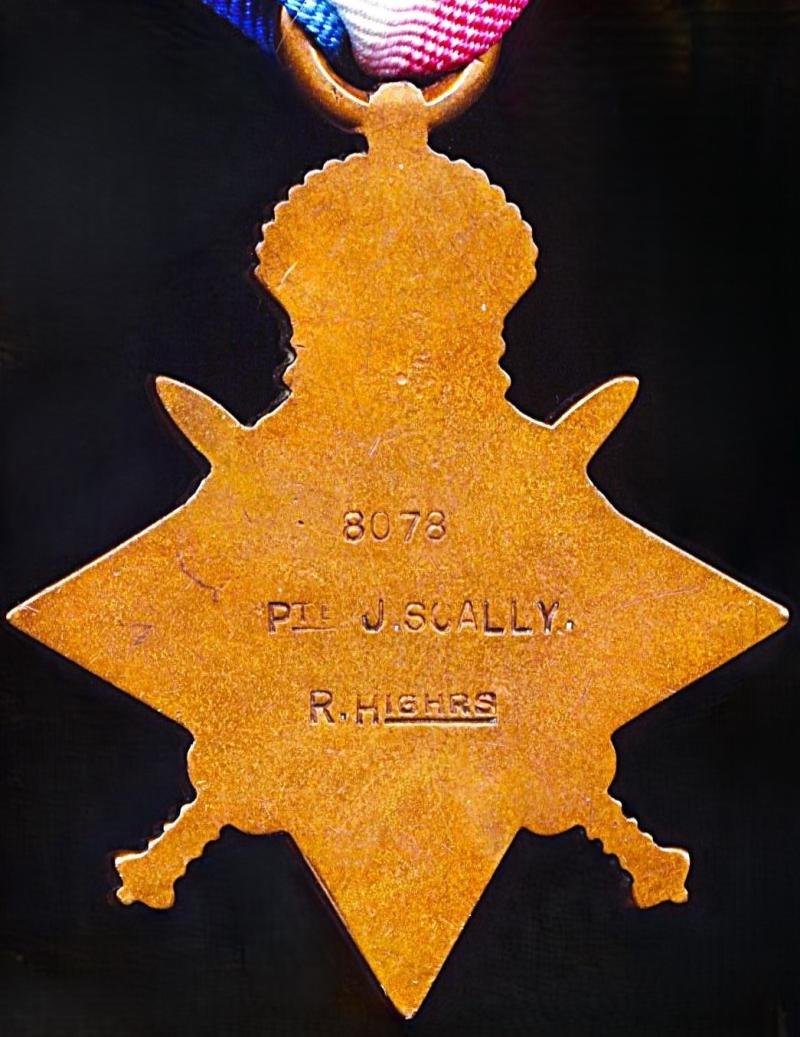
- 1914 Star. With contemporary dated clasp & silver rosette emblem (8078 Pte T. Scally. R.Highrs.)
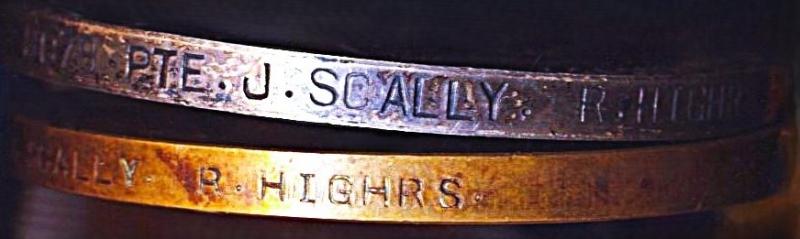
- British War Medal. Silver issue (8078 Pte T. Scally. R.Highrs.)
- Interallied Victory Medal (8078 Pte T. Scally. R.Highrs.)
Multiple Wounds-in-Action: Thomas Scally is confirmed having been 'Wounded-in-Action' in France & Flanders on at least 4 x different occasions in 1914, 1915 & 1918
Portrait Photograph: A portrait of Private John Scally wearing tropical kit tunic and a Royal Highlanders (Black Watch) pattern Glengarry hat with regimental badge was published in the 'Kirkintilloch Gazette' newspaper issue of 9 April 1915
Medal(s) & Clasp(s) Verification: Thomas Scally served in both the South African War and later as a recalled 'Reservist' with the Royal Highlanders (Black Watch) in the Great War, for which services he was awarded the below following 4 x medals & clasps:
- QSA Medal. With 3 x clasps 'CC', 'OFS', & SA 1902': WO 100/190 service with 2nd Black Watch
- 1914 Star. With dated clasp: WO 329/2460. Disembarked France 13/08/14
- British War Medal. Silver issue: WO 329/1352. Shows with 1st Royal Highlanders
- Interallied Victory Medal: WO 329/1352. Shows with 1st Royal Highlanders
Private John Scally, was a model Scottish soldier, tough. tenacious and loyal, as well as a prolific letter writer. Fortunately John came form a small community, and news from the front was generously supplied to the local press by his wife. Fortunately, the numerous newspaper articles that were published in the local press - and which now constitute a rich - and rarely seen - archive of biographical history of the services of a private soldier of the British Army in the Great War. The published articles - some of which were syndicated - are too many to here reference or quote, but the below following have been selected as being the most informative:
WOUNDED SOLDIER RETURNS HOME
The Herald newspaper issue of 12 February 1915, contained the below article:
Quote,
A BRAVE CONDORRAT SOLDIER
On Sunday morning Mrs. Scally, Condorrat, received official intimation that her husband, Pte. John Scally (No. 8078), 1st Black Watch, was dangerously ill, suffering from a shell wound in the buttock, and had been removed to No. 13 General Hospital, Boulogne. At the same time she received a postcard in which he stated that he had been again wounded - this time a severe hit. He lay all day in the trenches, which were almost full of water. Of course, he explained, "no one could get next or near me till night fall. The I was taken care of and removed to hospital."
Everybody, after becoming cognisant of the part Private Scally has played in this campaign, will admit that he is a brave soldier.
Prior to the commencement of hostilities he was working at No.11 Gartshore Pit as a miner, in the employ of Messrs Wm. Baird & Co. In August he was called up, being a reservist, and he has been in some of the hottest engagements ever since his regiment got into action. He is a son of the late Mr. Patrick Scally, Parkhead, Glasgow, whilst his wife hails from Dalbeattie. Some time ago he was wounded in both arms, and was removed to hospital.
From letters written privately to his wife one os able to find out what a brave soldier he is. Writing from hospital some time after he was first wounded he said:- "I would sooner be with my regiment than in hospital as I am able to go about. I have, nevertheless, suffered considerable pain in my shoulder with the bullet wound."
Another illustration of the fact can be found in the following, which is an extract from another letter written on another date - "I would sooner be out there with my wounds until it is finished rather then show the white feather and return home."
That Pte. Scally is proud of his regiment none can deny. In one letter he writes:- "Our regiment which has been out from the start, has done some surprising work, and I do not care who else says it, it consists of the best and hardiest class of men in the whole of the British Army."
That he has not been overlooked in the way of comforts, however, is evident, from a note wherein he writes:- "Do not send me Tobacco, as I have got plenty, till last me to next Christmas."
That Pte. Scally will once more have a speedy recovery we are sure is the sincere wish of all our readers.
Unquote.
On returning from France to Scotland in the Spring of 1915, the 'Kirkintilloch Gazette' newspaper issue of 9 April 1915, published the below following lengthy account of John's services from 'Mons' in 1914, where he was wounded in September 1914, and through to his second 'Wounds' in February 1915', and constitute an amazing record of service in the opening months of the Great War:
Quote,
WOUNDED SOLDIER RETURNS HOME
Private J. Scally who as a reservist, left with the Black Watch at the outbreak of the war, returned home to Condorrat on Friday. He has come through a lot of fighting and suffered badly from wounds, frost-bite and rheumatism. At the Aisne he was wounded in both arms. by shrapnel on 14th September, but did not then get home, being sent back to the fighting lines after treatment in France. One bullet went in at one side of his arm and had to be cut out at the other. He spent seven weeks in hospital. Private Scally's second wounds were come by at La Bassee. He bayoneted one of the Prussian Guards and was wrestling to release his bayonet when he was struck twice. Fortunately (he considers) he fell into a trench or he would have been alive to tell the tale to-day. He was in about nine bayonet charges and came through many counter attacks. Of all the engagements he witnessed, that at La Bassee was the worst. There seemed to be nothing but death staring them in the face, but the position had to be taken. As a holder of two medals for the South African campaign, he declares that the fighting then was only sport when compared to the present war. It was not war at all, but simply murder. The Black Watch were taken specially from Ypres to La Bassee for the charge. Arms, legs and heads were blown about in all directions, and there were not so many of the Prussian Guards left as we think. The Black Watch suffered badly in September, being practically led into a trap. The Germans had been waiting for them for a few days, and the Highlanders simply formed a target for them then. There were only about 500 of them left out of 1100 in September. When Scally left the fighting line he only knew of three of his original company who were left (including himself), and the other two were wounded as well. Though Private Scally was in the charge at St. Quentin, when the Black Watch were reported to have held on by the stirrups of the Scots Greys, he never saw such an occurrence, but he does not deny that there may have been instances where his comrades held on by the horses to help them along. He first heard of the incident when looking through a magazine while in hospital. Many things happened in a charge, however, which one could not notice. People at home would not believe what the soldiers who took part in the early stages of the war had seen. He had seen where children of four or five months had been sacrificed and pinned up on doors, while those to whom they belonged would be lying dead nearby. Many a time the British soldiers would have taken revenge, but for the restraining influence of their officers. Private Scally, like many other men who have come home, can tell of the damage done by German snipers, Altogether four bullets were taken out of Private Scally, besides bits of shrapnel.
Unquote.
With regards to John's fourth 'War Wounds', these were reported in several local newspapers including the Kirkintilloch Gazette issue of, 27 September 1918:
Quote,
Pte John Scally, Black Watch. whose home is in Main Road, Condoratt, has been wounded for the fourth time. This time he has been hot on both arms, both legs, and in the back. yet he writes from an Aberdeen Hospital to his wife in a very cheery strain asking her not to worry about him as he will come though it all right. He has been wounded at Douai near Arras. Pte Scally has been in the war since the start, being a reservist with a considerable amount of service. In pre-war days he was a miner.
Unquote.
John Scally son of John Scally (1859-1891 a 'Winder in Mill') and Anne Jane Scally (nee McCrory) was a native of Shettleston, Glasgow, Scotland, where he was born circa 1883. By trade a 'Lbourer', John declared himself to be 18 years and seven months of age when he attested for the British Army, at, Glasgow, Scotland, on 11 January 1902. He was posted to the Royal Highlanders (Black Watch), and joined the Regiment at Perth on 12 January 1901. John was no stranger to military life, as he cited prior service as a member of the 3rd (Militia) Battalion of the Highland Light Infantry. His terms of engagement were to be 7 years 'With the Colours' and ' 5 years with the Army Reserve. John's subsequent record of service with the Black Watch is summarised below:
- Home: 11/01/1901 - 02/01/1902
- South Africa: 03/01/1902 - 22/10/1902
- India: 23/10/1902 - 22/03/1904
- Home (Inc Army Reserve): 23/03/1904 - 12/08/1914
- France: 13/08/1914 - 07/02/1915
- Home: 08/02/1915 - 03/06/1916
- France: 04/06/1916 - 18/09/1918
- Home: 19/09/1918 - 13/04/1919
At the time of the Great War, John's wife Maria 'Mary' Scally (nee Limbert) and young family were resident at, Main Street, Condoratt, Croy, North Lanarkshire, Scotland
John Scally, is recorded to have died at Edinburgh. Midlothian. Scotland on, 28 January 1960
The medals mounted in the swing-style for display on a white metal mounting bar that retains its long hinged pin and clasp fittings
A superb record of endurance by a Black Watch 'Jock' who was wounded on multiple occasions during the Great War
Condition: VF
Code: 25714