


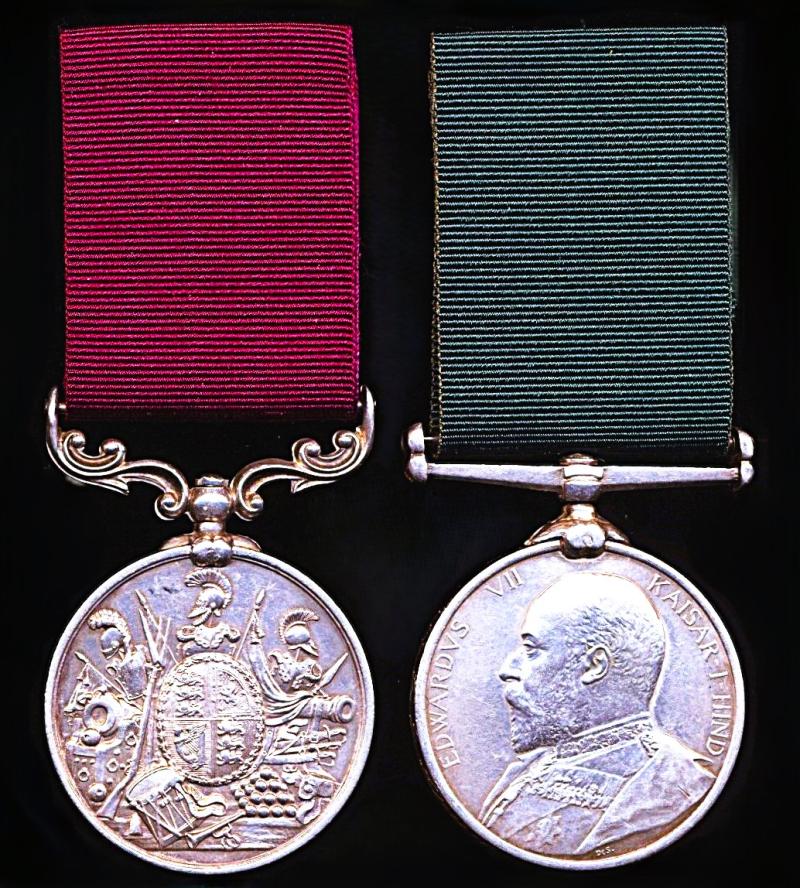
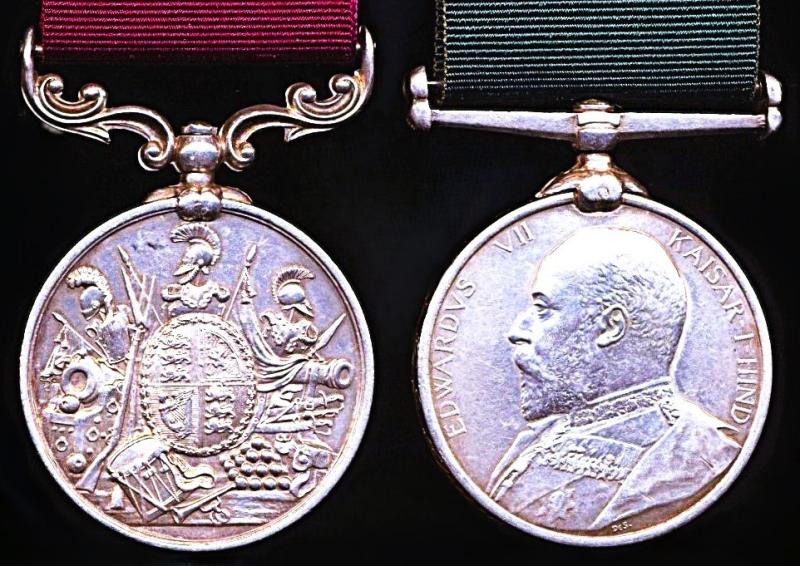
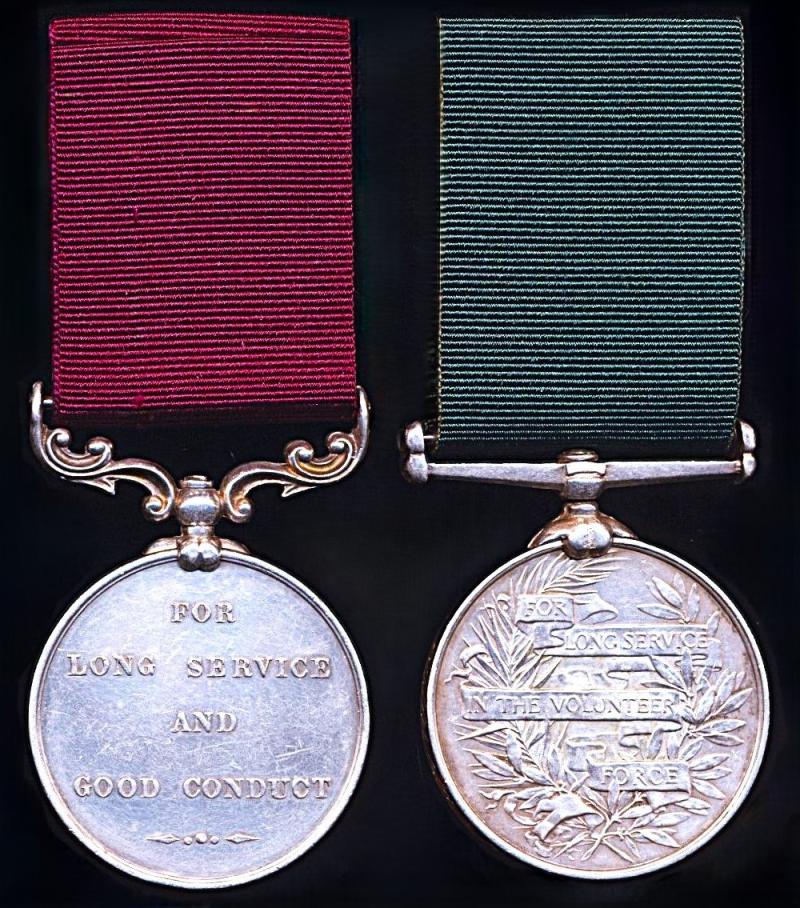
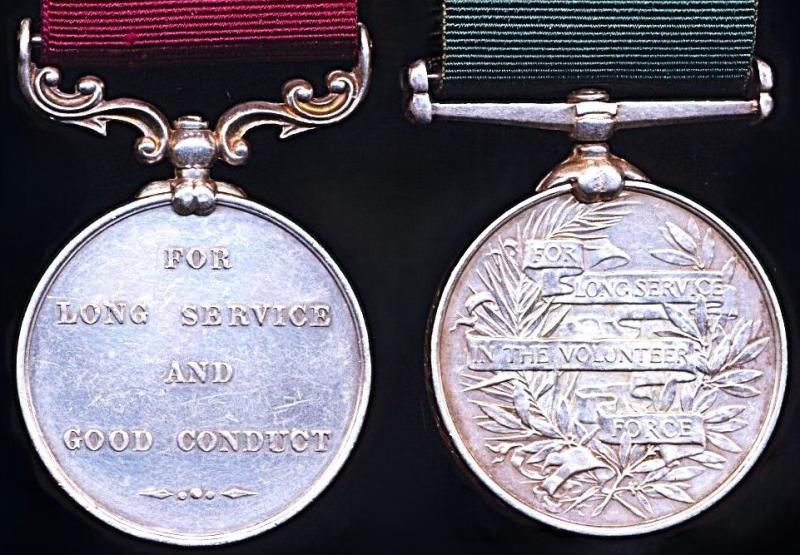
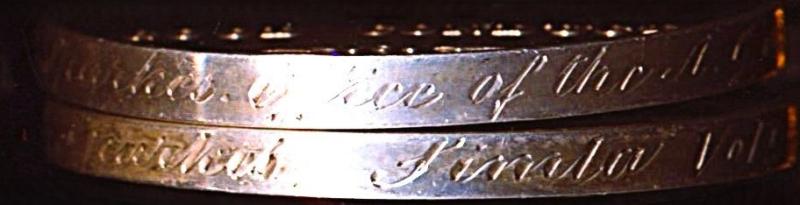
An unusual pair of Long Service medals for service in Simla, the Summer-Capital, of British India: Captain Thomas George Sparkes, Army Service Corps, late Simla Volunteer Rifles, Office of the Adjutant General's Office in India, & Royal Horse Artillery
- Army LS&GC Medal. Victorian issue (Condr. F. G. Sparkes. Office of the A.G. in India)
- Volunteer Long Service Medal (India & Colonies). EDVII issue (Volr. F. G. Sparkes. Simla Volr. Rifles.)
Medals verification: Medal rolls for the award of the Army LS&GC Medal awarded in India are not accessible on-line, however the recipients obituary refers to the recipient being awarded two long service medals. The award to Volunteer Thomas George Sparkes, Simla Volunteer Rifles, was published in India Army Order 469 of 1906, on which date there was just two medals awarded to the unit. Only an estimated 39 x Edward VII VLSM's awarded named to the unit in its designation as the Simla Volunteer Rifles
At the time of being awarded his Volunteer Long Service Medal. the recipient was holding the rank of Volunteer (Private) while serving with the Simla Volunteer Rifles
A rare instance of a serving British Warrant Officer of the Adjutant General's Office in India - and a long term resident of Simla where all his 5 x children were born between 1888-1904 - concurrently serving as a 'Volunteer' (not as an instructor) with the local European Volunteer unit, the Simla Volunteer Rifles
Chronology of the Simla Rifles: The unit was centred on the 'Hill Station' of Simla (the Summer Capital of British India) located in the Punjab foothills of the Himalaya mountain range (now called Shimla, in Himachal Pradesh state) and underwent a series of name changes during its history as under:
- 1861 raised as 2nd Punjab (Simla) Volunteer Rifle Corps on 2nd May
- 1897 restyled 2nd Punjab (Simla) Volunteer Rifles, January
- 1904 renamed the Simla Volunteer Rifles
- 1917 1st April, became the 4th Simla Rifles (Indian Defence Force)
- 1920 1st October, redesignated Simla Rifles (Auxiliary Force India)
Interestingly the unit had at least one and possibly two affiliated 'Cadet Corps'. In 1884 Bishop Cotton School (BCS) established a Cadet Corps and joined the unit as “D Coy” Simla Volunteer Rifles. In 1947, Freddie Brown, Schoolmaster at BCS, along with the British & Hindu boys had to ensure that 42 Pakistani boys were not harmed. Between 15 August to 21 Oct 1947, at night, under Freddie’s supervision, armed guards from the Simla Rifles cadets patrolled the dormitories, until the Pakistani boys were safely evacuated. Another school that was likely connected with the Simla Volunteer Rifles was the Lawrence Military Asylum, Sanawar, near Kasauli, which not only had a strong military background, but it is also known that the Principal of that school was, in 1923, also 2nd in Command of the Simla Rifles
Thomas George Sparkes, eldest son of George Sparkes (a 'Miller') and Helen Sparkes (nee Elliot) was a native of Cranleigh, Surrey, England, where he was born on 18 January 1860 (Indian Army List April 1896 refers). He is recorded enlisting circa 1876, at the age of 16 years. On joining the British Army, he was posted to the Royal Horse Artillery of the Royal Regiment of Artillery. On 30 September 1879, Gunner Thomas George Sparkes was holding the regimental number No. 2184 and serving with 'A' Brigade of the Royal Horse Artillery when he embarked on the 'Euphrates' for overseas service in British India - the embarkation record (his surname recorded as 'Sparks' (sic) show he had enlisted in the British Army on 16 March 1878 - which in light of his later published obituary - might actually be a start to his 'Adult' military service. He was evidently a model soldier, and enjoyed soldiering and living in British India, where he spent the majority of his 27 plus year in India stationed at Simla (now Shimla) - the summer capital of British India - being located in the Punjab foothills of the Himalaya mountain range. Thomas married Ann 'Annie' Elizabeth Cannon (17 years of age) at Simla, India, on, 7 November 1883 - the couple were subsequently blessed with at least 5 x children (4 x daughters and 1 x son), who were all born at Simla variously between 1888-1905. Thomas was appointed Sub-Conductor in the Adjutant General's Office in India effective 15 November 1895, and promoted Conductor effective 1 August 1898. He was commissioned Honorary Lieutenant and Commissary on 15 May 1905, and took his retirement from the British Indian Army effective on 1 January 1907
The below following obituary to Captain Thomas George Sparkes as published in 'The Herald' issue of 29 January 1938:
Quote,
WAITED FOR WAR WHICH NEVER CAME
DEATH OF CAPTAIN T. G. SPARKES
The Mayor (W. C. Birkett) stood in the ranks of members of a guard of honour of the Worthing British Legion at the funeral of Capt. Thomas George Sparkes. of South-Farm road, Worthing, which took place at Broadwater Cemetery on Saturday.
Members of both Men's and Women's sections of the Legion attended to pay tribute to Capt. Sparkes, who had been actively engaged in Legion work in Worthing for some years.
Capt. Sparkes had a distinguished military career. He was born in Cranleigh, Surrey, in 1861, and following an education at Cranleigh College, he enlisted with the Royal Horse Artillery at the age of 16. At Army headquarters at Simla he was appointed to the Adjutant General's office, and received a commission as a Lieutenant in 1905.
In 1887 he volunteered for service on the North West Frontier of India in anticipation of an invasion by the Russians, and spent two years in a tent in Kandahar waiting for a war which never took place.
27 YEARS IN INDIA
In all he spent 27 ½ years in India, and was in possession of long service and good conduct medals. For 15 years he was Secretary of the Bengal Presidency Rifle Association. He married in India in 1886.
Mr Sparkes also acted as a coffin bearer when the body of the Prince Imperial, who was killed during the Zulu war, was received for burial at Chislehurst. Invalided home from India in 1908, he was recalled in 1914, and took over duties in the R.A.S.C. as officer in charge of barracks at West Sandling, Kent. He was promoted to Captain in 1915, and retired in 1919. Captain Sparkes came to Worthing to live in 1930, and since then had been a prominent member of the Worthing branch of the British Legion.
BRITISH LEGION PAYS ITS HOMAGE
The funeral was conducted by the Recor of Broadwater, the Rev. B.C. Mowll, and a short service at the cemetery chapel was held prior to the internment.
The standard of the Men's section of the Legion was carried by Mr A. Westby, and that of the Women's section by Mrs Hollands. On behalf of both sections of the Legion a wreath was carried and placed on the grave by Mr G. Blackman, vice-chairman.
Poppies were scattered in the grave by Mr Brackstone.
Major-General R. E. Vaughan, president, and Major. J. M. Forsdyke, chairman were also present, and Captain C. Madden, county-chairman of the British Legion of Sussex, also attended.
The principal mourners were: Mr F.E. Sparkes, son; Mrs H.G. Golding, daughter; Mr and Mrs F.E. Sparkes, brother and sister-in-law; Mr. W.M. Sparkes, brother; Miss E. Sparkes, sister; Mr and Mrs C. Dorey, brother-in-law and sister; Mr S.B Little, son-in-law; Mr and Mrs A.H. Sparkes, and Mr and Mrs A.G. Sparkes, nephews and nieces; Mr Hugh Sparkes and Mr E.M. Sparkes, D.C.M., nephews; and Mr M. Bishop and Mr G. Ayling.
The widow and Mrs S.B. Little, daughter were unable to be present.
The funeral arrangements were carried out by Messrs A.H. Clarke and Son. Ltd funeral directors of Regent House, Lancing and Hove, under the personal supervision of Mr C.A. Clarke.
Unquote.
Condition: GVF
Code: 25719