


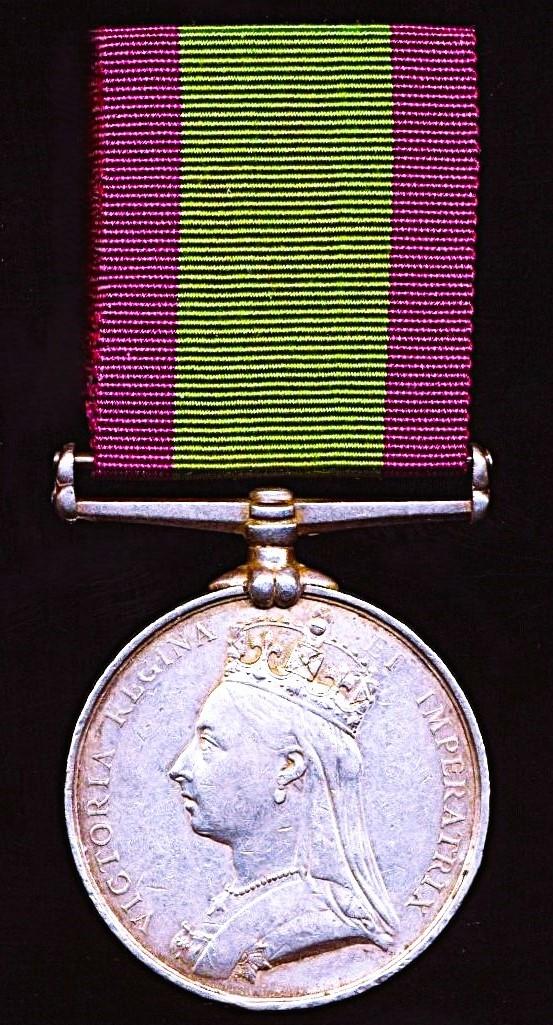


Afghanistan War Medal 1878-1880. No clasp (Naick Kalloo Chand 1st Goorkha Regt)
The recipient was by ethnicity a Nepalese soldier of the Newar caste and Hindu faith, who - traditionally - were local to the Kathmandu Valley, Nepal, who served as a Naick (Corporal) with the 1st Goorkha Regiment, of the British 'Bengal Presidency Army'
The following regimental abstract of service in the Afghan War 1878-80 is taken from the standard reference for that war, viz 'The Afghan Campaigns of 1878-1880 (S. H. Shadbolt, 1882)':
Quote,
1st GOORKHA REGT. (LIGHT INFANTRY).
Under the command of Colonel J. S. Rawlins, the ist Goorkhas L.I. moved from Dhurmsala, Lahore Division, in September, 1878, to form part of the force under Sir Donald Stewart assembled at Multan. Arrived there on the 9th Nov., the regiment railed to Sukkur, trans Indus, where it was employed till the 25 th Dec. in guarding the Siege Train, and loading and storing supplies and munitions of war.
During the month of December the ist Goorkhas moved in several detachments towards Kandahar, the Head-quarters, under Col. Sale Hill (Colonel Rawlins having been invalided), marching on the 26th in charge of the Quetta Field Park and a large ordnance convoy, the other detachments preceding it, escorting sections of the Siege Train and Treasure. The regiment finally assembled at Kan¬ dahar on the 13th Feb., 1879, forming part of the brigade under Brigadier-General Nuttall, and furnishing the rear and out-look picquets to the force, as well as numerous detachments as escorts, convoys, and foraging parties in the Kalat-i-Ghilzai direction and Argandab Valley. The work performed by the regiment up to and during this period was of the most arduous and harassing description, the difficulties encountered, especially in crossing the Khoja Mountains, being enhanced by the inclemency of the weather and heavy snow-falls.
On the 26th Feb., 1879, the regiment left Kandahar, forming part of the force detailed to return to India by the Thal-Chotiali route under Major-General Biddulph, and was attached to No. 2 Column. During the march the 1st Goorkhas almost invariably furnished the vanguard, a duty which entailed very harassing work, all heights having to be crowned, and the country reconnoitred. At Nahar-ki-kot the force was broken up; and on the nth April the regiment marched to India via the Chachar Pass, and finally reached its station, Dhurmsala, on 8th May, 1879.
In compliance with telegraphic orders, the 1st Goorkhas L.I., under the command of Colonel Sale Hill, again marched on service from Dhurmsala on the 26th Dec., 1879, and on the 22nd Jan., 1880, arrived at Fort Jamrud, where it was posted to 2nd Brigade Reserve Division, Lt.-Colonel Story now assuming command vice Colonel Sale Hill, who was appointed a Brigadier-General in the Field.
The regiment was employed during the months of February and March in guarding the Khyber Pass and furnishing escorts and convoys, one company, under Lieut. Kempster, being detached at the latter end of March to escort Mr. Scott while surveying to the North-East of the Kabul River and the country adjacent to the Sumshai Pass and the Shiliman Range.
On the Reserve Division being broken up, the 1st Goorkhas L.I. was attached to the No. 1 Moveable Column at Safed Sang, and took part with it in the Kuggia and Hissarak expeditions, and the operations in the Lughman Valley.
Subsequently to these operations, from the 16th June till the breaking up of the Khyber Line Force on the 10th Aug., 1880, the regiment was employed in keeping the line of communication, and stationed at Jagdalak Kotal and Seh Baba, was constantly engaged in patrolling, and crowning the heights for, and guarding convoys. These duties were effectively performed ; and during the whole period, the safety of the road was thoroughly secured.
On the 11th Aug., 1880, the regiment commenced its return march to India, and after re-crossing the frontier, eventually made its way back to Dhurmsala, where it arrived on the 26th Sept., 1880.
Unquote.
The 1st Goorkha Regiment were originally raised at Sabathu in 1815 as the very first 'Gurkha' infantry regiment of the East India Company's 'Bengal Army. On formation, the regiment was called 1st 'Nusseree' Battalion. Subsequently called 1st Gurkha Rifles (1901), the regiment serves in the present-day Indian Army as, 1st Gorkha Rifles (The Malaun Regiment), and has the distinction of being the oldest Gurkha Rifles regiment, raised by the British, and which has remained in continuous military service through to and including 2019
1st Gurkha Rifles were awarded the below following battle honours for their campaign services prior to 1900;
- Aliwal
- Sobraon
- Afghanistan 1878-80
- Punjab Frontier
- Tirah
Condition: VF
Code: 25834