


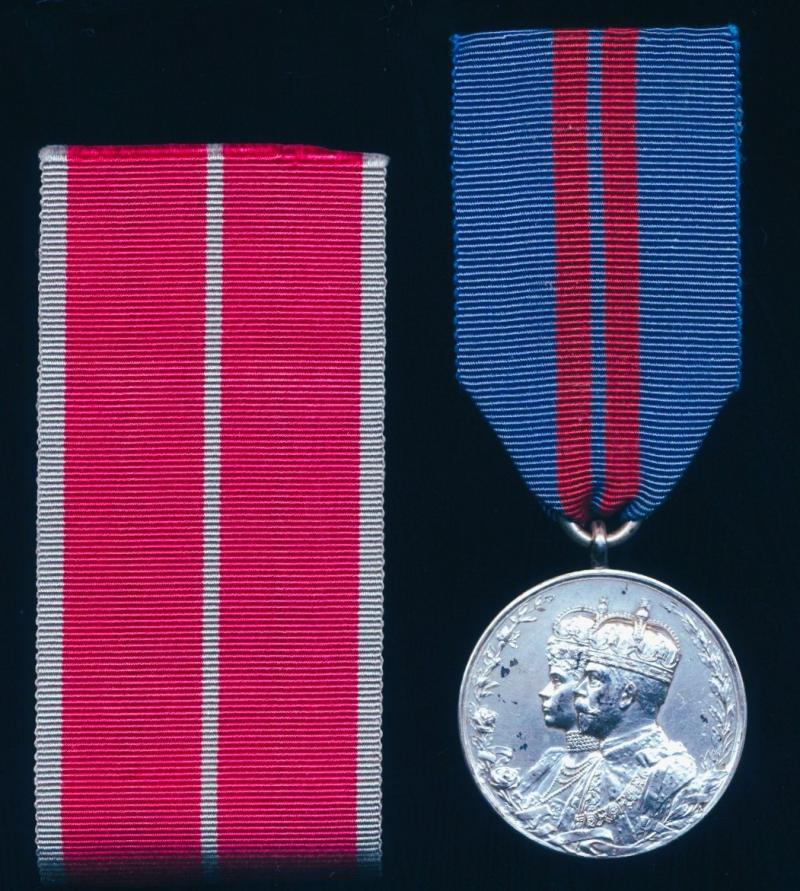
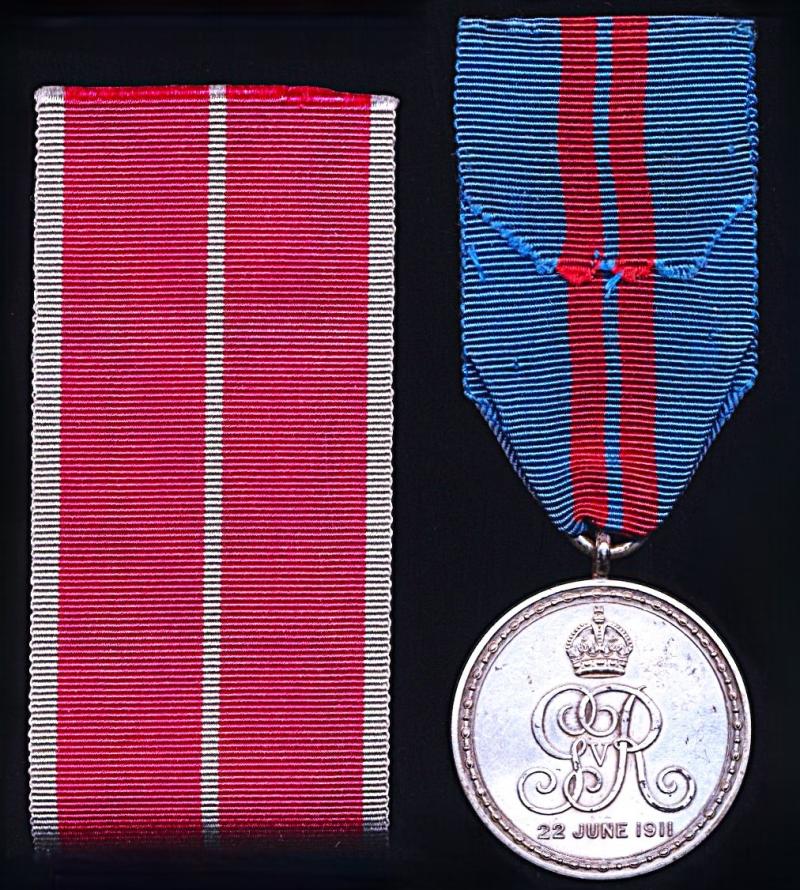
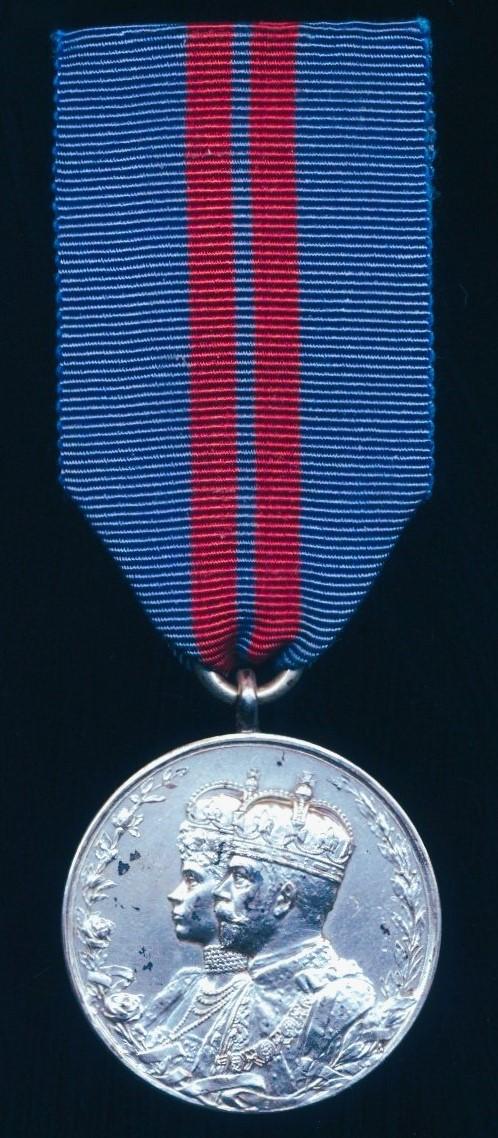
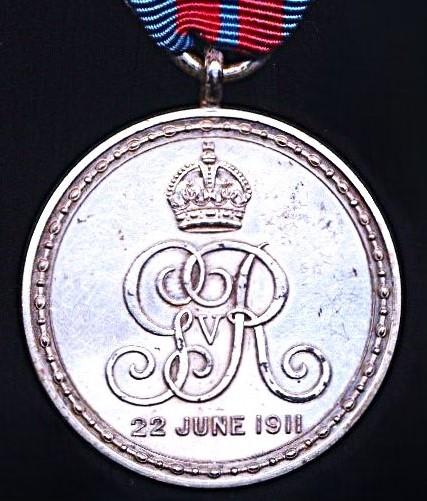

Coronation Medal 1911. Silver (Colonel Richard Woodforde Deane. Commandant R.H.M. School.)
The medal is contemporary engraved named in sloping capitals
The recipient was Colonel Richard Woodforde Deane, Lancashire Fusiliers who was awarded the medal in his capacity as holding the appointment of Commandant of the Royal Hibernian School, Dublin, Ireland - an appointment he held from 4 July 1906
During his long military career, Richard Deane attained high rank, and many qualifications, including French language and Hindustani of which he was graded 'Interpreter'. He served overseas as under:
- India: 20/09/81-26/12/85
- Malta: 26/08/98-20/03/00
- Barbados & Trinidad: 20/01/02-19/11/03 in West Indies he was Officer Commanding Troops, Trinidad
In spite of his many years service, he never earned any campaign medals, his only medals being the award of the Coronation Medal 1911 and later the Commander of the Order of the British Empire (Military Division) and a Mention-in-Despatches in respect of 'Home Services' during the Great War
The C.B.E. published in London Gazette of date, 3 June 1919.
The preamble to the award stating:
Quote,
CENTRAL CHANCERY OF THE ORDERS
OF KNIGHTHOOD.
St. James's Palace, S.W.,
3rd June, 1919 -.
The KING has been graciously pleased, on the:
occasion of His Majesty's Birthday, to give orders for the following promotions in, and appointments to, the Most Excellent Order of the British Empire, for valuable services rendered in connection with the War: —
'Deane, Lt.-Col. & Bt. Col. Richard; Woodforde, r.p., late Staff'
Unquote.
An estimated 15901 x medals were issued (Ref 'Coronation and Royal Commemorative Medals' (Howard N. Cole, London 1977)
Richard Woodforde Deane son of Richard Wallace Deane (Reverend 1821-1893) and Anna Eliza Deane (nee Woodford) was a native of the parish of St. Pauls, Bedford, Bedfordshire, England, where he was born on 31 August 1859. Richard was educated at Bedford School, Marlborough College and Trinity College (Cambridge Univeristy). He was commissioned in the Lancashire Fusiliers 1881; Captain., 1890; Major, 1898; Lieut.-Col., 1903: Officer Commanding Troops 'Trinidad'; Commanded the 4th Battalion Lancashire Fusiliers, 1903-6; Brevet-Colonel, 1906. Appointed Commandant of the Royal Hibernian Military School, Dublin, 1906-13; retired. During the Great War, 1914-19, in command of the Lancs. Fusiliers Depot, 1914, and of No. 3 District, 1915-18; Mentioned-in-Despatches; Awarded C.B.E. (Military), 1919. Married, 1892, Harriett (sic), daughter of late G. Blencowe, of Bineham, Chailey, Sussex. Latterly resident of Oldlands, Hassocks, Sussex. Died there 5 February 1940, aged 80 years. Buried at Keymer (Reference The Times, Feb. 6, 1940; Marlborough College Register; Who's Who
The Royal Hibernian Military School: Was founded at, Phoenix Park, Dublin, Ireland in 1769, to educate Irish children who were orphans or the children of Irish servicemen of the British Army where a parent had died, or the family was otherwise destitute.
The foundation of the School came about in 1769 when King George III granted a Charter of Incorporation on 15 July, the School Governors holding their inaugural meeting on 6 November in Dublin Castle. The school did not open until 6 March 1770 with school pupil roll of 140 children, including 50 girls
By 1808 the system and organisation of the school followed closely that of its sister school, the Duke of York's Royal Military School (then at Chelsea, London, England). By 1816, when Thomas Le Fanu (father of Sheridan Le Fanu) took over as chaplain, there were 600 children at the school
In 1853 the school's first 'stand of colours' were presented by the then Prince of Wales and, in the same year, the girls at the school left to join their own separate establishment, the Drummond School, which was founded for them at Chapelizod. Even before this, in the eighteenth century, there had been more boys than girls at the school
The school was intended to act as a feeder to the British Army, where in the mid-19th century, children as young as 12 could enlist in the Army but generally enlistment began at 14. In the eighteenth century, boys were more likely to go into other occupations than into the army. In the period 1850-97, about 50% of the boys enlisted in the British Army, while a statement made by Earl Roberts in 1909 reported that 80 per cent of RHMS pupils were going straight into the army on leaving the school. By this stage the school was regarded as an excellent source of competent soldiers and non-commissioned officer
A uniquely named medal of considerable Dublin, Ireland, historical interest
The sale is for the Coronation Medal 1911 only - the C.B.E. riban is not included, and has only here been included as a prop for illustrative purposes
Condition: GVF
Code: 25931
125.00 GBP