


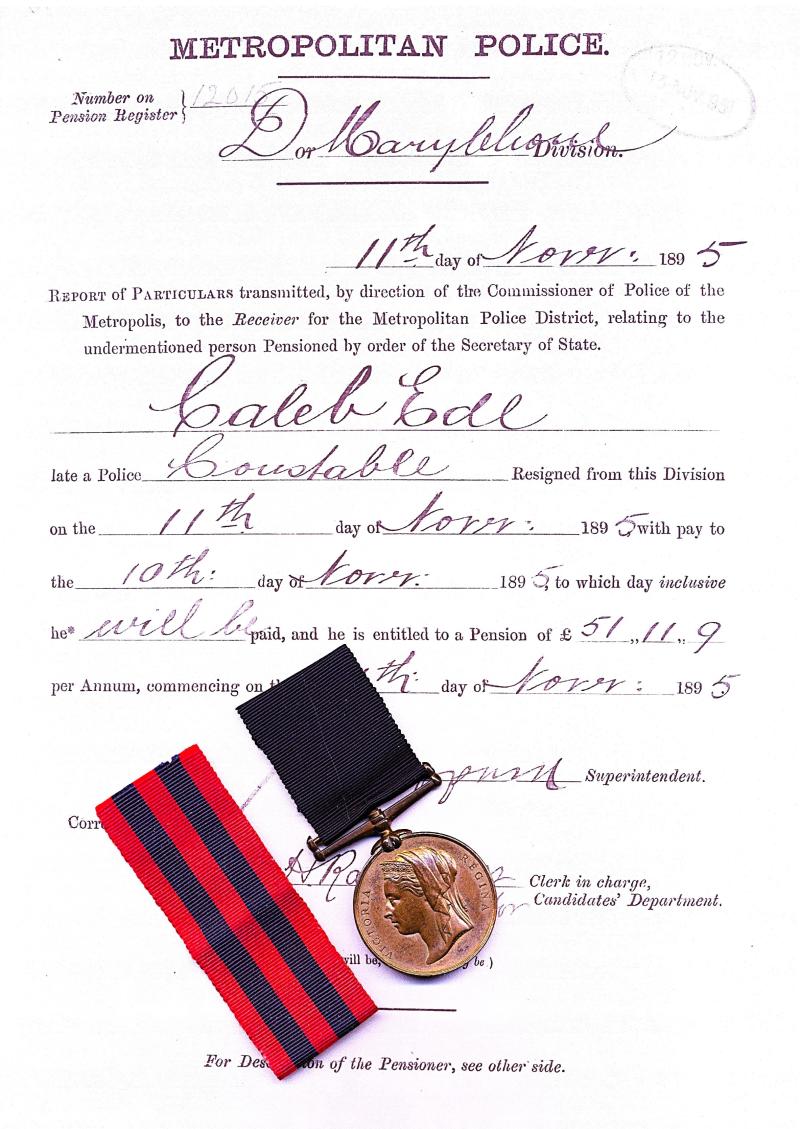
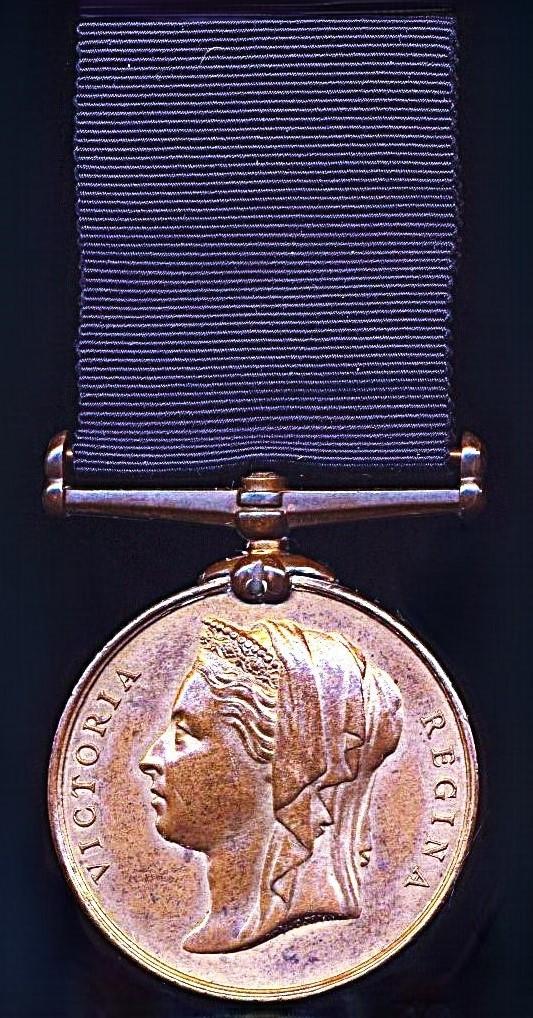
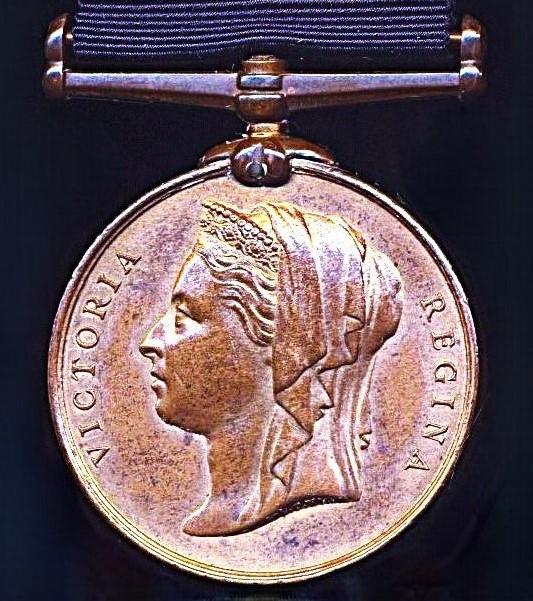
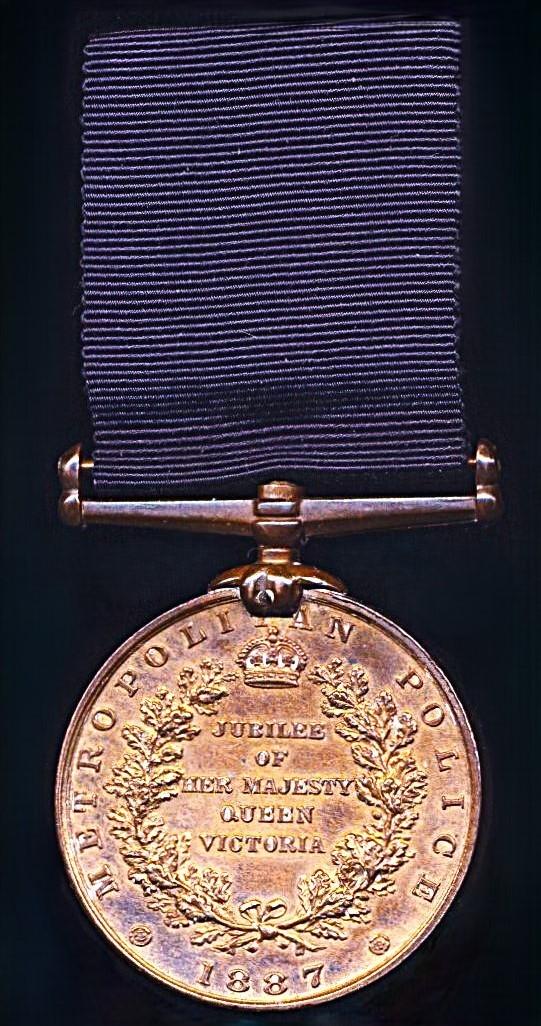

Jubilee Medal 1887. Metropolitan Police reverse issue. No clasp (P.C. C. Ede. D. Div:)
The recipient was Police Constable Caleb Ede of 'D' Division of the Metropolitan Police
The recipient was a former soldier of the British Army (No 1989 Private, 3rd Battalion Rifle Brigade) who served overseas in British India on active service with the 3rd Battalion Rifle Brigade. During his deployment in India, he fought on the North West Frontier for which service he was awarded the India General Service Medal 1854-95, with clasp 'North West Frontier' (reference the respective campaign medal roll WO 100/20). The British Army World-Wide Index for 1861, records Caleb stationed at Bareilly Cantonment, Bengal, India. Shortly after his return to the United Kingdom, and completion of his short service engagement with the British Army - the IGS 1854 medal roll shows he took his discharge on 12 February 1869 - after marriage in 1870, Caleb applied for and joined the Metropolitan Police, with which force he subsequently served in 'E' & 'D' Divisions, in a police career that spanned just over 25 years
It is estimated that 14,000 x 1887 Jubilee Medals with the 'Metropolitan Police' reverse legend were issued to 'All Ranks' of the Metropolitan Police, including 'Pensioners' of the Metropolitan Police, who served on public duties during the Golden Jubilee ceremonies of 1887
Important: There are several mentions / articles (far too many to reference or quote here) pertaining to Constable Caleb Ede in the Victorian local London newspapers of the era he served - several concerning acts of violence - and most interestingly his part in a 'Gruesome Discovery' that Police Constable Caleb Ede made in the early days of the sensational 'Body Parts Murders', that blighted parts of London immediately preceding the 'Jack The Ripper' case. Reference article published in the 'Morning Advertiser' issue of 11 November 1884:
Quote,
DISCOVERY OF HUMAN REMAINS
Dr. Danford Thomas held a lengthened inquiry yesterday at the St. Gile's Coroner's Cour, on the mutilated remains of a human body which had been found on different occasions in several parts of the metropolis since the 23rd October.
- George William Peck, Gardener of Bedford-square enclosure, stated that on October 23rd , at 7.15 a.m., whilst at work in the garden, he noticed some pieces of flesh. He was going to throw them over into the road, when he discovered an arm. He then gave information at the Tottenham-court-road police-station, and a constable came and removed them.- By the Coroner: They had been packed up in a newspaper and brown paper. It had been thrown over the railings, as their was some lime on the spike pf the same kind as on the flesh. - By a Juryman: It was on the west side of the square, nearest to Tottenham-court-road. - Police-constable CALEB EDE, 31 E.R., stated that he accompanied witness to the square and found five or six portions of a human body covered in lime, which he put in a basket and conveyed to the police-station. - William Meager, scavenger to the St. Giles's authorities, stated that on the morning October 23, at seven o'clock, he had started from the end of Tottenham-court-road and continued through Alfred-mews to clear the dustbin of Hewetson and Thexton, and about sixteen yards from the bin he noticed a newspaper parcel, but as they saw so man parcels containing cats and fish, he took no notice of it, and shovelled it into the cart. He afterwards heard that it was found to be a human head.- Joseph Rawlinson, carman to Cookson, contractor, stated that when he took his load to the Great Northern Railway he found the parcel contained a head, and the foreman said he had better take it back to the district where it was found. - Geroge Means, porter in the employ of the Great Northern Railway, stated that on the morning in question he saw a piece of flesh under the truck, and as the head had been found in the truck, Mr. Williams, the superintendent, ordered it to be detained, until searched by the police. - Inspector Summers said that at 1.15 p.m.on the 23rd October he went to the Great Northern Railway, and had the truck searched, with the result that he found a large portion of human hair, covered with the same type of white powder, smelling of the same odour as the flesh - Police-constable John Watts, 305 E, said that on morning of October 29th, at 7.30, as he was passing through Fitzroy-square, he noticed in the area of No. 33 a quantity of flesh. As he had heard of a portions of a human body having been found in several places, he asked the caretaker of the house to let him go down and look at them. He then founds the parts of a lower trunk spread about at a distance of a foot from each other. - By a Juryman: They were covered with a white sort of powder which smelt very strong. - Detective-sergeant Rowan stated that police had not up to the present time obtained any clue as to how the several pieces were deposited. - Dr. Samuel Lloyd, divisional surgeon of the 'E' division, stated that he had examined the several pieces, and from the appearances of the several parts there was no doubt they were those of a woman, the hands, face, and hair being smooth and long. The parts had the appearance of having been divided by someone skilled, but not for the purposes of dissection. The body was not complete, as there were several parts deficient . The age could not be less than 25. - The Coroner said that on the 25th Sept, a parcel was found in the enclosure of Mornington-crescent by a man named Charles Fitch, and was seen by Dr. Jenkins of Albany They were removed to the St. Pancras mortuary and afterwards buried. they consisted of a right arm, a right and left foot, and left forearm, Dr. Jenkins, giving his opinion that they belonged to a young person. (Addressing Dr. Lloyd:) Would they be the parts required to complete the body: - Dr. Lloyd: Yes, but not quite all, - The Coroner: How ere the parts divided? - Witness: I should think by some heavy instrument like a hatchet. Certainly not with a knife, a saw only being used to cut down the chest. - A juryman having asked the doctor to give a theory of how the death was produced, Inspector Langrish said the police were still proceeding with their investigation, and if an adjournment was made they might perhaps be able to find a clue. - The Coroner acquiesced, and said the Home Secretary would be communicated with for the purpose of offering a reward and giving order for the exhumation of the body.
Unquote.
The above incident referred to as the 'Tottenham Court Road and Bedford Square Mystery' remains unsolved in 2026
The Tottenham Court Road Mystery was reported by The Times on 24 October 1884, relating to the discovery of parts of a woman's body:
- A skull, still with flesh attached to it
- A chunk of flesh from a thighbone.
Near Tottenham Court Road, in Bedford Square, a woman's arm was found in a parcel. This arm had been tattooed, showing that it might have belonged to a prostitute.
A human torso was found in a parcel by a police constable as he passed 33 Fitzroy Square five days later. The parcel was believed to have been placed at the location between the hours of 10:00 and 10:15.
Evidence was presented in an inquest on 11 November, held at St. Giles Coroner's Court. This concluded that the body parts came from a woman and that they might have been divided by someone who was skilled, but not for the purpose of anatomy.
The inquest resumed on 9 December. More evidence was presented and showed, as stated by Dr Jenkins, how the body, from a woman, was skillfully dissected. This evidence was the right arm, both feet, and the right forearm of a single individual.
These two mysteries still remain unsolved in 2026.
Caleb Ede, eldest son of Josiah Ede (an Agricultural Labourer) and Eleanor Ede (nee Whitmore) was a native of, Reigate, Surrey, England, where he was born, 6 April 1836. circa 1845. His name does not appear in the 861 National Census as he was serving overseas in British India, (No 1989 Private 3rd Battalion Rifle Brigade). On return to the United Kingdom, and after taking his discharge from the British Army (12 February 1869), Caleb joined the Metropolitan Police, which Police Force he joined at Scotland Yard on, 7 November 1870. By the time of the compilation of the National Census for England and Wales in 1871, Caleb is recorded living. together with his wife Elizabeth (nee Stedman who he had married on 19 February 1871), at 23 George Street, in the parish of St. Giles, Finsbury, London, England. his employment described as 'Police Constable'. Caleb Ede, served firstly with 'E' & later 'D' Divisions of the Metropolitan Police. He served a total o 25 years and 3 days towards pension, through to 10 November 1895, transferring to the Pension the following day 11 November 1895. At discharge from the Metropolitan Police Caleb was described as a 'Widower' - his wife with whom he had been blessed with 7 x children, had died during the third quarter of 1887. In later retirement Caleb Ede, has relocated to his native roots in Reigate, Surry, where he is recorded to have died sometime during the third quarter of 1908, and where his body was laid to rest on 2. September 1908
A most desirable Metropolitan Police issue medal to a 'Bobby' who had fought 'Pathan' tribesmen on the North West Frontier, which no doubt toughened him for the future 'London Mean Streets' and brawls he is recorded as encountering in his Police service - and not least his pivotal role played in the opening gruesome stages of the of the infamous 'Tottenham Court Road Mystery'
The sale is for the Jubilee Medal 1887 only, and does not include the IGS 1854 riband that has only here been illustrated as a prop for research / provenance purposes
Condition: About EF
Code: 25933