


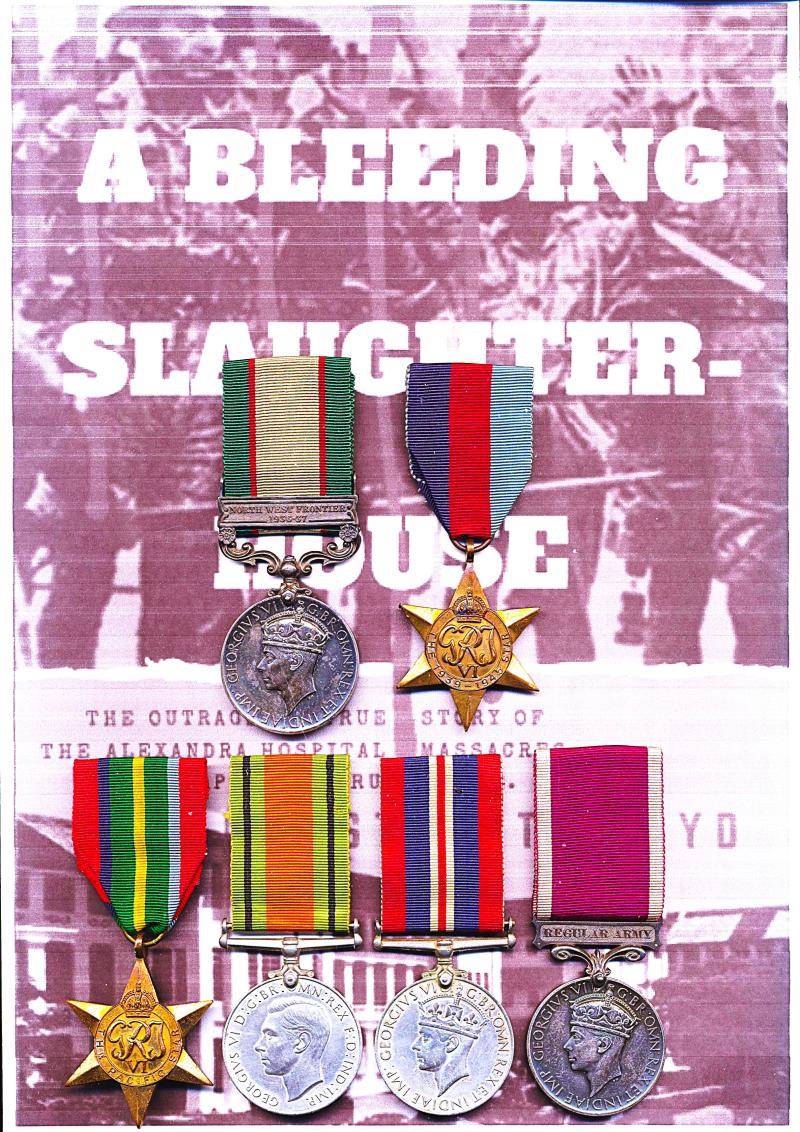
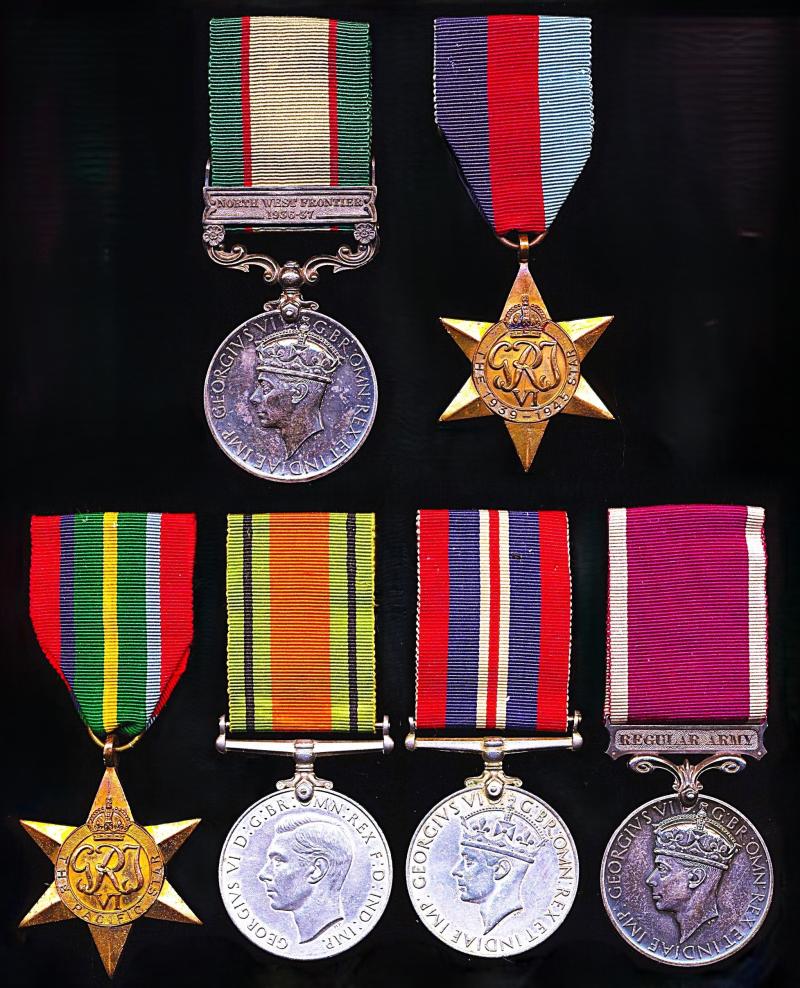
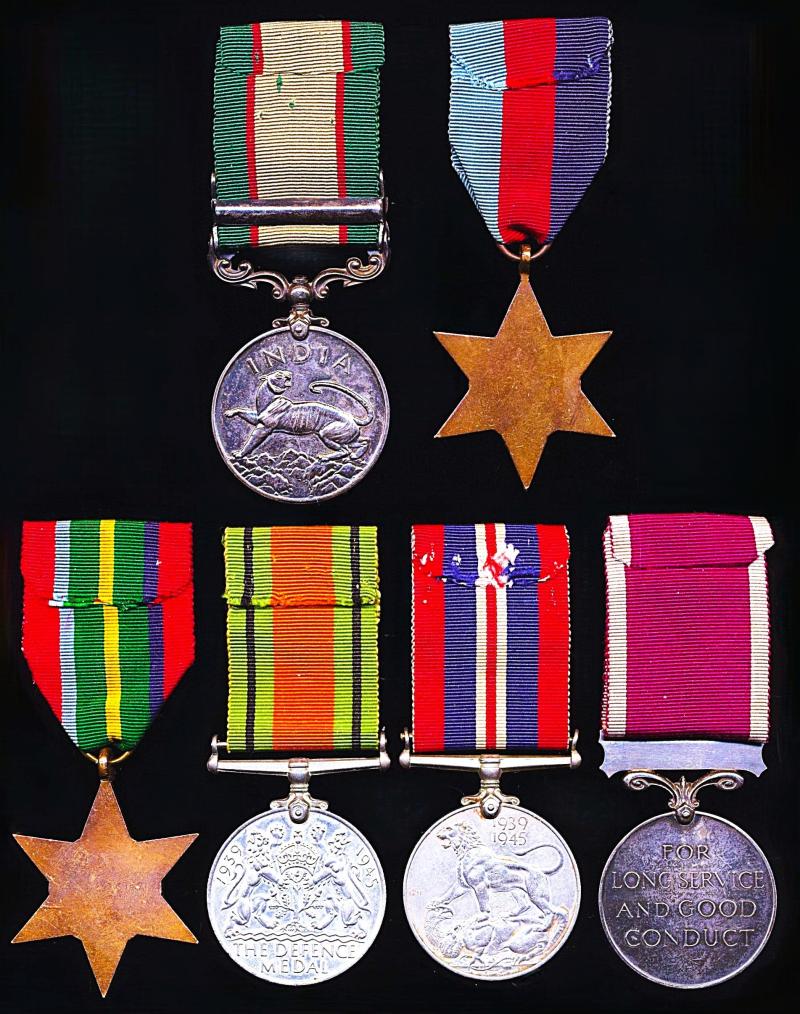
An extremely scarce to unit North West Frontier & Fall of Singapore Far East Prisoner of War medal group of 6: Quartermaster Sergeant Clifford Seaton late 32nd Company Royal Army Medical Corps, Alexandra British Military Hospital, Singapore Colony
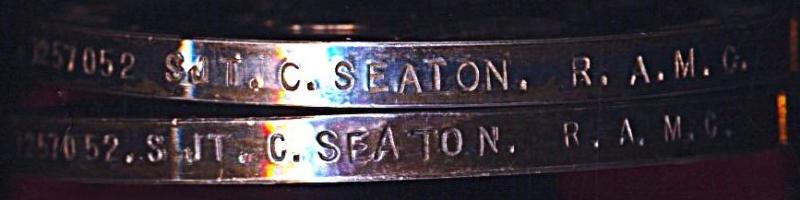
- India General Service 1936-39. Clasp 'North West Frontier 1936-37' (7257052 Sjt. C. Seaton. R.A.M.C.)
- The 1939-45 Star
- The Pacific Star
- Defence Medal
- War Medal
- Military Long Service & Good Conduct. GVI I 'Regular Army' bar (7257052 Sjt. C. Seaton. R.A.M.C.)
Alexandra British Military Hospital Singapore: Clifford Seaton was holding the senior NCO rank of Quartermaster Sergeant, serving with 32nd Company Royal Army Medical Corps, when he was captured at Singapore Colony on 15 February 1942. 32 Company R.A.M.C., a 'Hospital Company', were deployed to Singapore Colony in October 1940, where they were based at the brand new Alexandra British Military Hospital - which at that time was the largest and state of the art military medical hospital in South East Asia.
Alexandra Hospital Massacre: On 14 February 1942, infantry of the Imperial Japanese Army advancing on Alexandra Hospital were fired upon by British Indian Army Troops from within the grounds of the hospital. After breaking the engagement, the Indians against all oncoming odds, scattered in retreat through the grounds of the hospital. The battle hardened enemy troops pressed their attack and subsequently swarmed through the hospital grounds and the hospital itself, where they killed, murdered and bayonetted patients, doctors, nurses and orderlies, including those on operating tables and in their beds. Those British and Empire troops in the hospital not able to escape, were rounded up, and the following day - on the day of the surrender of Singapore Colony - were mostly massacred
As of 2026, there is NO definitive list of names of all those who were present in the Alexandra Hospital when it was attacked, and or who were killed in the massacre, or even those that survived / escaped.
For a detailed eye witness account of the Alexandra Hospital Massacre, listen to the account of Charles Henry Lyons, 32 Company R.A.M.C., who left a detailed oral history recording his experiences during the massacre that can he heard in great detail and clarity from the Imperial War Museums Collection. Cut and paste below link into your search engine:
https://www.iwm.org.uk/collections/item/object/80010529
Whether Quartermaster Sergeant Seaton was present or not at Alexandra Hospital on 14/15 February 1942, is currently only speculative - what is certain is that he survived the 'Battle of Singapore, and would have personally known many of his comrades who perished in the infamous massacre
Act of Sabotage as a Far East Prisoner of War: Interestingly, the recipients extant FEPOW Liberation Questionnaire, shows that he performed an act of 'Sabotage' while incarcerated as a Prisoner of War in Singapore Colony, as cited below:
Quote,
I helped to bury and mark as 'Fouled Ground' three anti-aircraft gun barrels of large calibre in Roberts Hospital area early in 1942. These gun barrels were British.
Unquote.
Medals Verification: As of 2026, Second World War medal rolls for the British Army are not accessible in the public domain, and British Army Medal Index Cards for the Royal Army Medical Corps are similarly not known to be extant. However, the recipients entitlement to all medals and clasp is confirmed per the award criteria (WO Code No 1911 'Campaign Stars and Commemorative Medals Instituted for the 1939-45 War (The War Office 11 June 1948)) and the source cited below:
- India General Service 1936-39. Clasp 'North West Frontier 1936-37': WO 100/499 31 Coy R.A.M.C.
- The 1939-45 Star: Awarded for 1 day service in theatre from 8 December 1941
- The Pacific Star: Awarded for 1 day service in theatre from 8 December 1941
- Defence Medal: Awarded for 6 months service in theatre prior to 8 December 1941
- War Medal: Awarded for 28 days service
- Military Long Service & Good Conduct Recipient completed 18 years qualifying service on 18/03/41
Rarity: The India General Service Medal 1936-37 with clasp 'North West Frontier 1936-37' is an extremely scarce issue to 'Other-Ranks' of the Royal Army Medical Corps. The only 'Other Ranks' of the Royal Army Medical Corps to qualify and receive the India General Service Medal with clasp 'North West Frontier 1936-37' were a detachment from 31 Company R.A.M.C. The medal roll for 31st Company Royal Army Medical Corps shows 50 x 'All-Ranks' on the medal roll, that was signed at Deolali, India on 11 November 1938. Sergeant Seaton's medal was one of 35 x medals issued to OC 31 Coy R.A.M.C. on 19 January 1939, the balance 15 x medals were issued variously on other dates
Clifford Seaton, third & youngest son (of four children) of Charles Pass Seaton (a Grocer & Beer Retailer) and Ada Seaton (nee Lindley), was a native of Sheffield, Yorkshire, England, where he was born on, 5 May 1900. At the time of the compilation of the 1921 National Census for England & Wales, Clifford is recorded employed as an 'Electrical Engineer' (his later Japanese POW Card shows him described as an 'Electrician') and residing with his parents and two siblings (sister Ida Seaton a& brother Eric Seaton) at;
20 & 30
Valley Road
Sheffield
Clifford enlisted in the British Army on March 1923, on which date he was posted to the Royal Army Medical Corps and given the unique British Army Number 7257052, which was from the block 7245001-7539000 allocated to the RAMC. in 1920, and awarded sequentially circa 1920-41 to all new enlistees to the British Army who on joining were posted to the RAMC. After service with 31 Company RAMC in India in the 1930's, during which he served on the North West Frontier during the Waziristan Campaign of 1936-37, Clifford was transferred to 32nd Company RAMC, which unit deployed to Singapore Colony in October 1942, as the RAMC 'Hospital' Company based at the British Military Hospital, the newly built & commissioned Alexandra Hospital. In 1941 Clifford was a Warrant Officer (II Class), holding the appointment of Quartermaster Sergeant. He was fortunate to survive the Battle of Singapore, and his years of incarceration as a Far East Prisoner of War
Cliffords extant Japanese Red Cross POW Index Card records that his wife was his notified next-of-kin, who in 1942, was residing at:
23 Rowland Road
Highfield
Sheffield
Clifford Seaton's extant POW Liberation Questionnaire (held & accessible at The National Archives) records his internment history in Singapore as under:
- Fullerton Buildings (Hospital): 15/02/1942 - 02/03/1942 (the building is a luxury hotel in 2026)
- Roberts Barracks (Hospital): 02/03/1942 - 00/09/1943
- Selerang Barracks (Hospital): 00/09/43 - 00/05/1944
- Kranji Camp Hospital: 00/05/1944 - 00/08/1945
After liberation in August 1945, Clifford returned to his roots in Sheffield, where his address as shown on his FEPOW Liberation Questionnaire was:
12 Nether Edge Road
Nether Edge
Sheffield
Yorkshire
Latterly Clifford Seaton relocated to Aylesbury, Oxfordshire, England, where he lived at, 11 Edinburgh Place, Aylesbury. He is recorded to have died at the St. Johns Hospital, Stone, Buckinghamshire, England, on 5 August 1964
A most desirable medal group to the Royal Army Medical Corps
Condition: Silver medals age toned with patina about EF
Code: 25978