


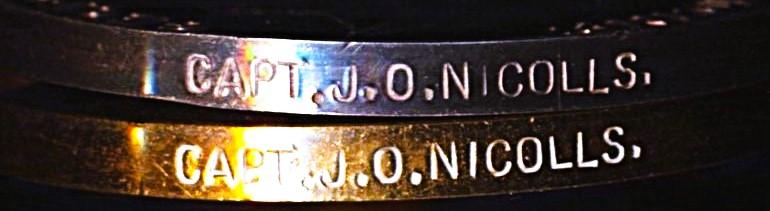
An 'Indian Corps' British Officer Killed-in-Action & Mentioned-in-Despatches for 1st Day Battle of Loos: Captain John Oliver Nicolls, 58th Vaughn's Rifles, Indian Army
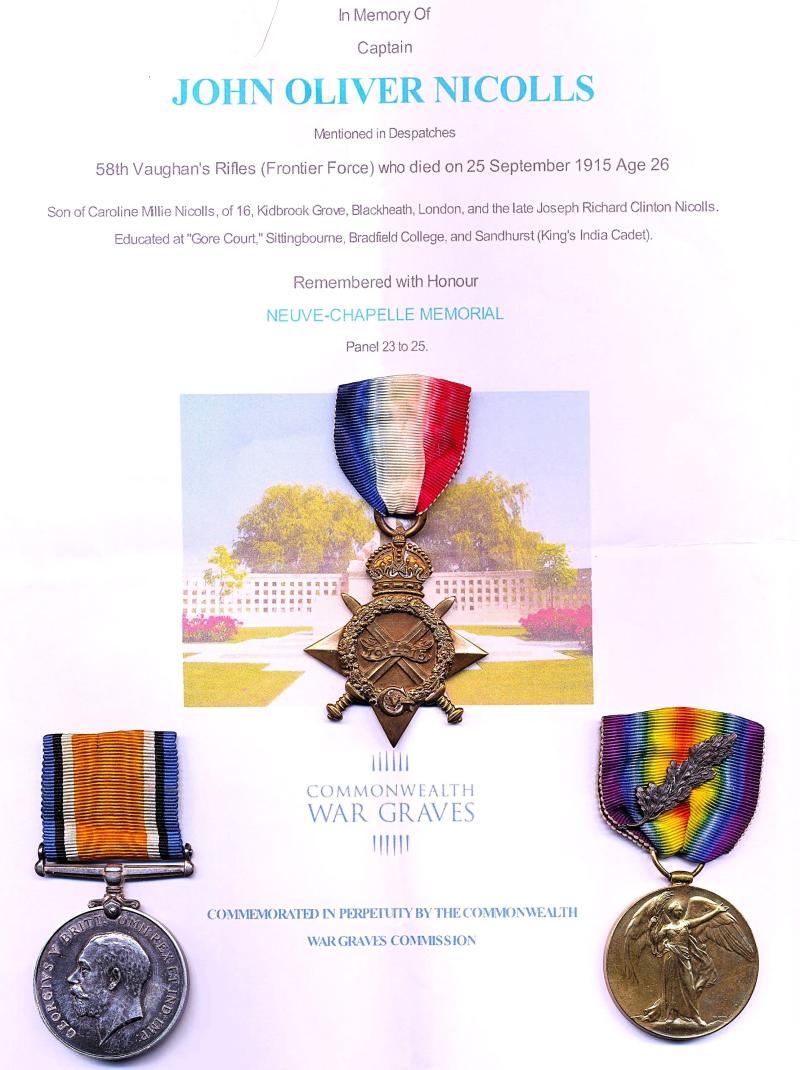
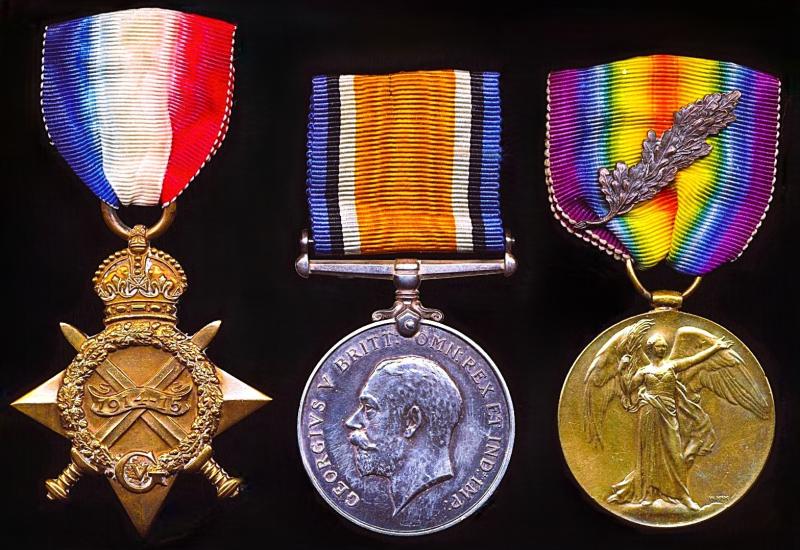
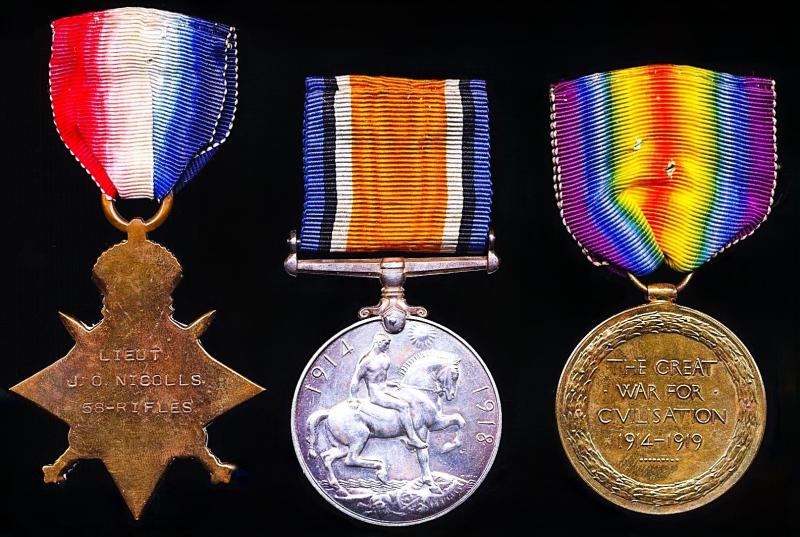
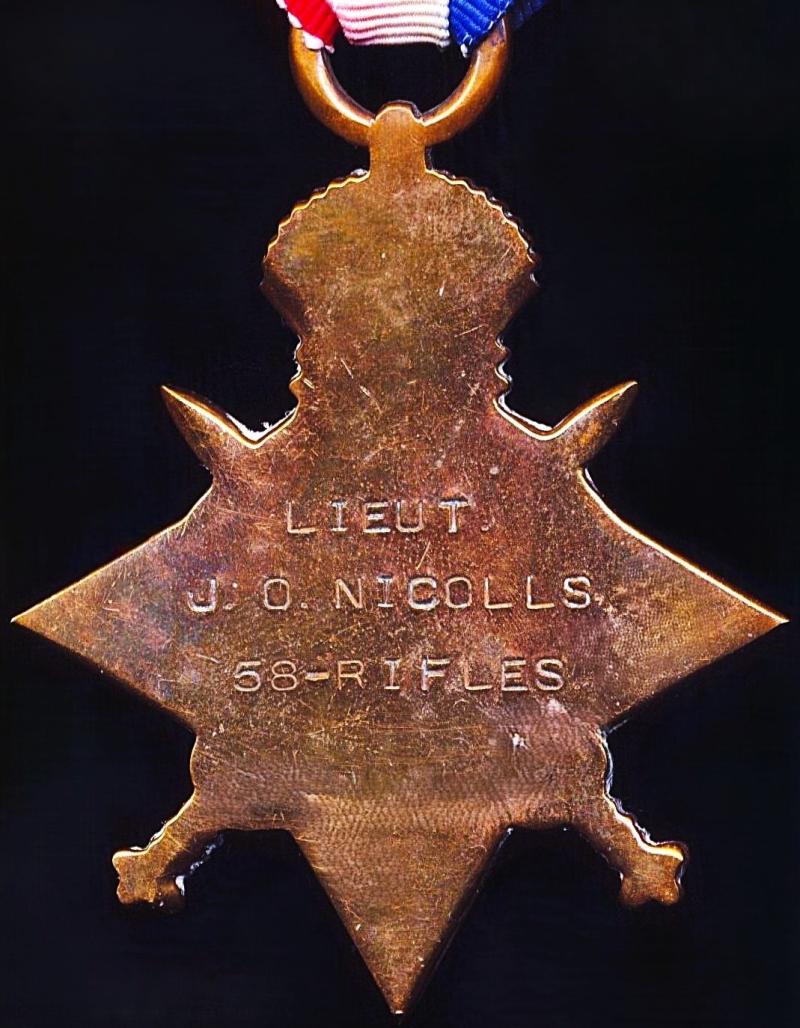
- 1914-15 Star (Lieut J. O. Nicolls. 58-Rifles.)
- British War Medal. Silver issue (Capt. J. O. Nicolls.)
- Interallied Victory Medal. With original MID 'Oakleaves' emblem (Capt. J. O. Nicolls.)
Medals Verification: All 3 x medals & Mention-in-Despatches are confirmed as entitlement per below referenced Indian Army medal rolls and London Gazette authority:
- 1914-15 Star: WO 329/2940. Medal roll compiled India Office & dated 06/01/1921
- British War Medal. Silver issue: WO 329/2347. Medal roll compiled India Office & dated 16/09/1921
- Interallied Victory Medal: WO 329/2347. Medal roll compiled India Office & dated 16/09/1921
- MID: Posthumous for gallant & distinguished conduct in the field LG 15/06/1916
Important: At the time of the Battle of Loos in September 1915, the only awards that British Officers could be awarded 'Posthumously were the Victoria Cross or a Mention-in-Despatches - at the time neither the Distinguished Service Order, or the Military Cross had provision to allow for the award of posthumous D.S.O.'s or M.C.'s to British Officers who had been killed or had died of wounds!
When the recipients MID was gazetted, it was one of only 2 x awards awarded to 58th Vaughn's Rifles - both were posthumous awards - awarded respectively to Lieut. J. O. Nicolls, and his Commanding Officer Maj (temp. Lt-col) C.E.D. Davidson-Houston D.S.O., both who were 'Killed-in-Action, on the first day of the Battle of Loos, on, 25 September 1915 - and both shown as 'killed'
The preamble to the award of the Mention-in-Despatches, published in the London Gazette dated 15 June 1916, states:
Quote,
War Office,
15th June, 1916.
The following despatch has been received by the Secretary of State for War from General Sir Douglas Haig, G.C.B., Commander-in- Chief of the British Force in France:-
General Headquarters,
30th April, 1916.
SIR,—I have the honour to forward herewith the names of those under my command whom I wish to bring to notice for gallant and distinguished conduct in the field.
I have the honour to be,
Sir, Your obedient Servant,.
D. HAIG, General,
Commander-in-Chief
The British Forces in France.
Unquote.
Captain John Oliver Nicolls, 58th Vaughan's Rifles (Frontier Force), Indian Army, was the son of Joseph Richard Clinton Nicolls (1856-1905), Civil Engineer in the Department of Public Works in India) and Caroline Millie Nicolls (only daughter of the Reverend Dr Cawston DD, Royal Navy, late Chaplain of the Fleet), of 16 Kidbrook Grove, Blackheath, London. Baptised on 12 June 1889 in Cawnpore, Bengal, India (now Kanpur, Uttar Pradesh, India). Educated at Gore Court, Sittingbourne, Kent and Bradfield College, Berkshire. Gentleman Cadet at the Royal Military College, Sandhurst (King's India Cadet). Commissioned into the Indian Army (unattached list) as a 2nd Lieutenant on 9 Sep 1908. He was posted to 58th Vaughan's Rifles on 11 Dec 1909. Promoted to Lieutenant on 9 Dec 1910. The 58th Vaughan's Rifles were mobilized at the start of WW1 and were deployed to France as part of the 21st Bareilly Infantry Brigade, 7th (Meerut) Division, landing at Marseilles on 11 Oct 1914 (John did not move with his battalion in 1914, being retained at the Regimental Depot in India - he arrived in France with a reinforcement draft in early August 1915). He was killed in action near Neuve Chapelle on 25 Sep 1915, not long before his regiment was withdrawn from France and sent to Egypt in late 1915. He is commemorated on the Neuve-Chapelle Memorial in France. He is also commemorated on the Bradfield College WW1 Memorial Cross on the Quadrangle, East of the Chapel, Bradfield College, Bradfield, Newbury, Berkshire, England (see: https://www.iwm.org.uk/memorials/item/memorial/41387) and on the Indian Army WW1 memorial in the Royal Memorial Chapel, RMA Sandhurst, Camberley, Surrey Heath Borough, Surrey, England
Reference the regimental history 'A Record of the 58th Rifles F.F. In The Great War' (Colonel A. G Lind, 1933), the below following mentions of John Nicolls and information has been drawn:
John is first mentioned at the beginning of the war on the very first page, where they write that “Captain A.A. Smith was detailed to command the Depot assisted by Lieutenant J.O. Nicolls. The depot was to be formed at Chaman for the time being, with the prospect of being subsequently moved to Multan.”
He is next mentioned on an entry joining the regiment with reinforcements:
“On the 17th August 1915, a draft consisting of Lieutenant J.O. Nicolls, 2nd Lt J.W.E. Jamieson IARO, 3 Indian Officers and 213 other ranks joined the Battalion. Of these 2 Indian Officers and 88 other ranks were of the 54th Sikhs F.F. the remainder being from our own Depot in India. This draft was of good physique, well trained, and far above the average of recent reinforcements from various sources.”
They then write of his services at the Battle of Loos where he was killed.
A full account of the Battle of Loos from the regimental history will be placed below, John's entries were;
“At 6.15am No II Company (P.M.) under Lieutenant NICOLLS on the left – and No IV Company (P.M.s of the 123rd Rifles) under Captain Mackenzie, and 2nd Lieut C.M. Durnford on the right, crossed the parapet and advanced some 400 yards. No II Company here went ahead, and No IV Company, whose commander, Captain Mackenzie was now Missing, stayed on the line marked A-A on the Map IV, where they commenced to dig in.
Whilst advancing alone to reconnoitre a trench to his front, LIEUTENANT NICOLLS was killed by a bomb: this was at the bend of the Winchester Road, marked ‘C’ on the sketch.”
They later write that due to heavy casualties to the officers present “the above account of this disastrous action is necessarily incomplete and unconnected owing to the loss of all British and Indian Officers who were in a position to give a connected account of what orders were given and what actually took place. The whole of the battalion headquarters were killed or missing and with them all orders and papers received and issued from the time the action started.”
They write in an analysis:
“1.) There was no organised method of Mopping-Up the captures trenches as the front line advanced such as became a ‘sine qua non’ in all attack orders later on.
The line appear to have advanced as far as possible without clearing the trenches of enemy, of whom a large number must have remained concealed at odd times, especially during the enemy counter-attack and caused us considerable loss.
LIEUTENANT NICOLLS was certainly killed by enemy in a trench which the first line has passed over: and Capt Mackenzie also, who with an orderly, had gone down a side trench to reconnoitre: and neither were ever seen again.”
Account of the Battle of Loos from the regimental history:
“On the 22nd September confidential orders were received for operations which were to commence on the 25th at dawn. These operations, known afterwards as the Battle of Loos—cost the Indian Corps in general, and the Bareilly Brigade in particular exceedingly heavy losses.
On the evening of the 24th September the Battalion which was in Brigade Reserve relieved the 9th Gurkhas in Ind 5 “B” sub-section—its strength being, British officers 9, Indian officers 12, other ranks 581. At about 5.50 a.m. on the 25th September—the front line of the Bareilly Brigade, consisting (from left to right) of the Black Watch, the 1/4th Black Watch (Territorials) and the 69th Punjabis, advanced to the attack. The orders for the 58th Rifles were to occupy the front line held by the Black Watch immediately that Battalion went over the parapet. This was done: the line being occupied by about 6 a.m. The initial attack was most successful: in fact, so far did our first line advance that it was very shortly out of sight.
At 6.15 a.m. No. II Company (P.M.) under Lieutenant Nicolls on the left—and No. IV Company (P.Ms. of the 123rd Rifles) under Captain Mackenzie, and 2nd-Lieutenant C. M. Durnford on the right, crossed the parapet and advanced some 400 yards. No. II Company here went ahead, and No. IV Company, whose commander, Captain Mackenzie was now “missing”, stayed on the line marked “A—A” on map IV, where they commenced to dig in. Whilst advancing alone to reconnoitre a trench to his front Lieutenant Nicolls was killed by a bomb: this was at the bend of the Winchester road, marked “C” on the sketch.
No. I Company (Pathans) under Captain Wardell and 2nd-Lieutenant Deane-Spread and No. III Company (Sikhs and Dogras) under Captains Harcourt and Flagg, together with Battalion headquarters, now came up and pushed through Nos. II and IV Companies: and working up the communication trench east of point “C”, reached the German second line, which they occupied on the line “B—B” and began to consolidate. Here it became apparent that the attack of the Garhwal Brigade, on the right of the Bareilly Brigade, had failed to make sufficient ground for the Bareilly Brigade to advance further without unduly exposing its right flank. At about 10.30 a.m. parties of the 12th Rifle Brigade, whose rôle, it was understood, was to form a defensive flank on the left of the Bareilly Brigade, began to come upon the “right” of No. IV Company and an order was heard “12th Rifle Brigade close on your right”. This Battalion appears to have closed on its right, exposing our left flank—and very shortly afterwards the enemy heavily attacked this flank, and our line began to fall back. No. II Company, under Subadar Tikka Khan, made great efforts to hold up the enemy but expended all their bombs and all the enemy bombs (about 35) which they could find. The enemy’s attack was well organised and vigorously pushed and by noon there was nothing left but to get back to the original line in as good order as possible. On muster being taken it was found that 8 British and and 6 Indian officers and 246 other ranks were killed, wounded or missing. The remainder of the Battalion under 2nd-Lieutenant C. M. Durnford (the sole surviving British officer of those who had gone into action) was relieved in trenches at 6 a.m. on the 26th September and marched back to billets at Pont-du-Hem.”
The medals all fitted with their original silk 'moire' ribands, these all bright and thread stitched
A most desirable group of medals to a British Officer of the Indian Corps, who was 'Killed-in-action' during the First Day of the Battle of Loos, and for which action he was subsequently awarded a posthumous award of a Mention-in-Despatches for 'Gallant and Distinguished Service in the Field' for his deeds performed on the First Day of the Battle of Loos.
Condition: About EF
Code: 26032