


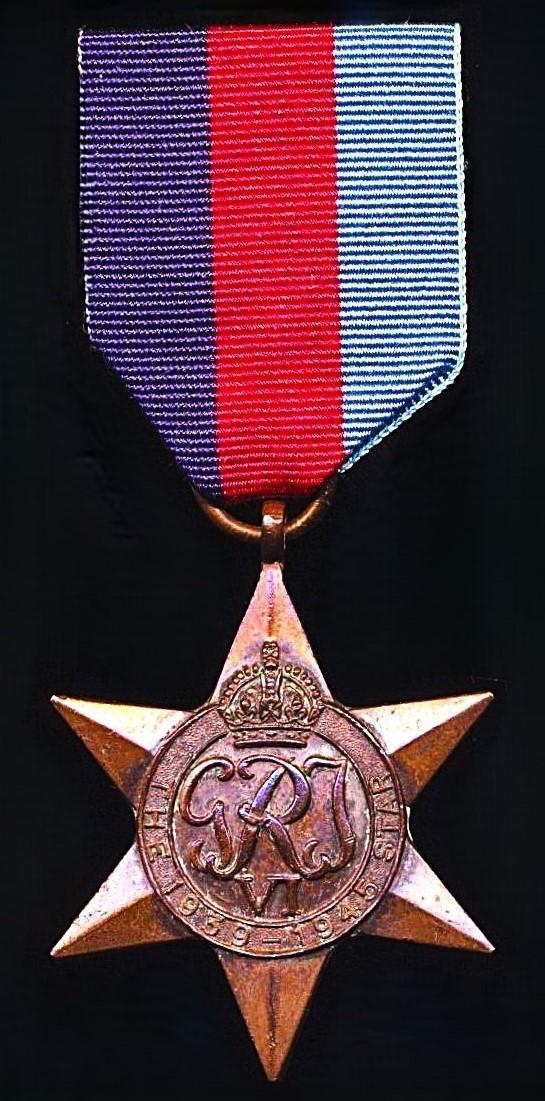
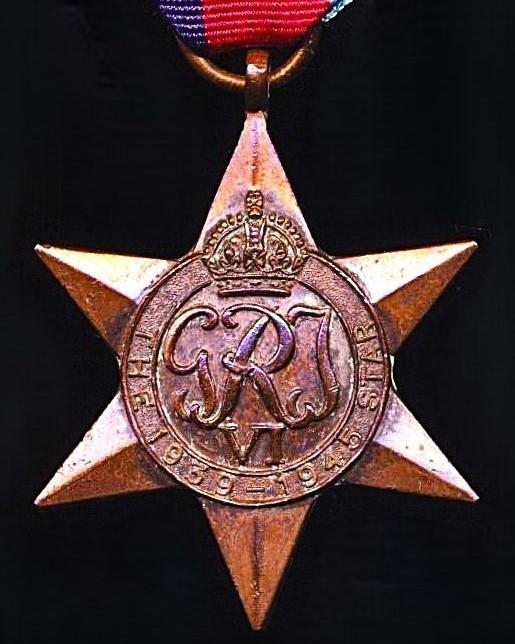
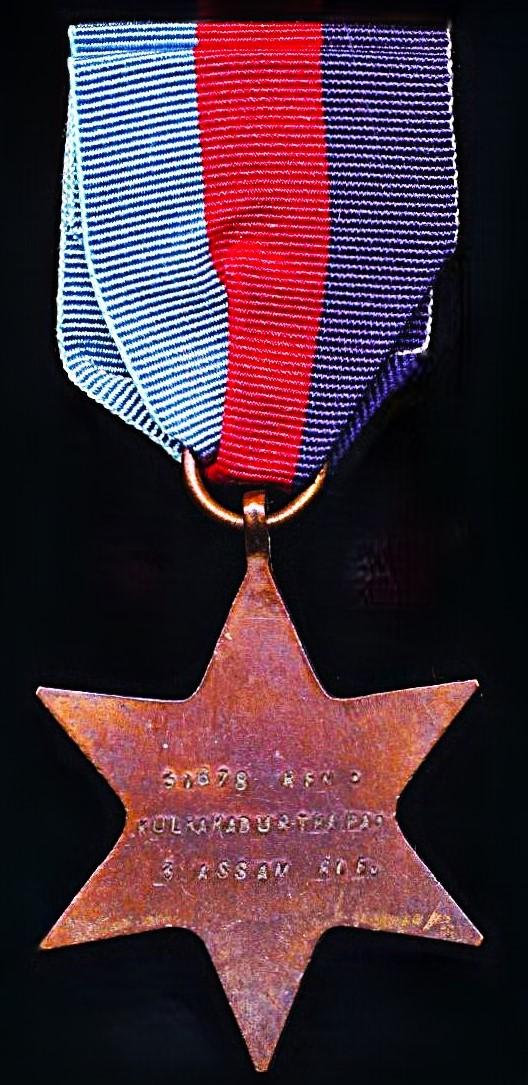
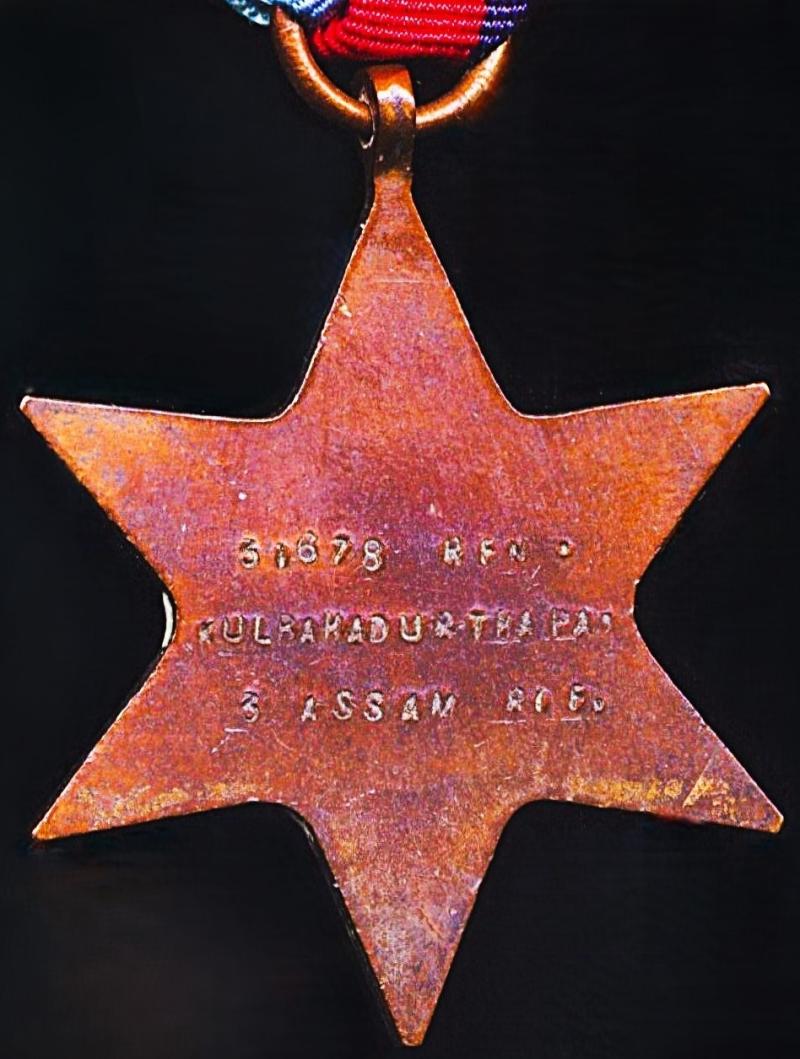
The 1939-45 Star. No clasp (31678 Rfn. Kulbahadur Thapa., 3 Assam Rif.)
The medal is an officially impressed named medal struck at the Calcutta Mint
The recipient Kulbahadur Thapa was a Nepalese soldier of Gurkha ethnicity and the Hindu faith whose origins were in Western Nepal, who was holding the rank of Rifleman while serving with the 3rd (Naga Hills) Battalion Assam Rifles
Original Defender Unit Kohima Garrison: 3rd (Naga Hills) Battalion Assam Rifles has the distinction of being one of the two - seriously depleted - Assam based units that provided the majority of combat troops in the original garrison at Kohima, from the start of the 'Defence' through to the period of the breakthrough by British 2nd Division - the defence ran from 3 -18th April 1944.
On 3rd April 1944, the combat troops comprised several platoons of 3/Assam Rifles and about 300 men of the magnificent 1/Assam Regiment (both these units had fought and bloodied the spearhead of the Japanese onslaught, in the battles of Kharasom and Jessami (with detachments of both units scattered in the nearby nearby hills, but outside of the garrison defensive perimeter), with the rest of the garrison comprised of the Shere Regiment of the Royal Nepal Army, and a mixture of stragglers and support arms the majority of which belonged to the British Indian Army. The very last troops to supplement the garrison priorwere the depleted 4th Battalion Royal West Kent's, and a weak company of 4/7 Rajput Regiment, which much needed reinforcements arrived on 5 April, just before the Japanese pincers cut-off Kohima. In the subsequent epic defence approx 2500 British Empire troops of which no more than 1500 were combatants took on a complete Japanese troops estimated at 15000 combatant - in what became the defining battle of the entire Burma Campaign 1941-45 - the Gurkhas and Nagas of 3rd Assam Rifles, repulsed numerous furious Japanese attacks on their positions. Whether the medal recipient, Kulbahadur Thapa, was amongst the ranks of the brave defenders is not presently known, but what is more certain is that his unique regimental number falls well within the spread of regimental numbers recorded in posterity by the Commonwealth War Graves Commission, for the fallen of 3rd Assam Rifles who died in the Defence of Kohima, and the wider battle for Kohima, that immediately preceded, and or, followed the Defence of Kohima 3-18 April 1944
For their collective services during the Second World War, the below following awards (not including many more Mentions in Despatches) were gazetted to members of the Assam Rifles:
- MBE: x 3
- MC: x 5
- OBI: x 4
- IOM: x 1
- IDSM: x 15
- MM: x 13
- BEM: x 7
The Assam Rifles often referred to as the "Sentinels of the North East" is the oldest paramilitary force in India. It was raised in 1835 as the Cachar Levy, a militia to protect tea gardens and the fertile plains of Assam against unruly hill-tribes. Its scope increased with the expansion of the 'British Raj' in Northeast India, and it was used continuously to counter insurgencies in the region. The force was redesignated as Assam Frontier Police in 1883, Assam Military Police in 1891, and East Bengal and Assam Military Police in 1913. It got its present name in 1917
Prior to the independence of India, in 1947, the cap badge of the Assam Rifles comprised crossed 'Kukri's' - a bow to the largely 'Gurkha' ethnicity of the units recruits - with a subsidiary title scroll 'Assam Rifles'. After independence the cap badges of Assam Rifles were modified to incorporate 'Asoka's Lion' emblem on top of the crossed Kukri's, and retaining the subsidiary tile 'Assam Rifles'
A scarce seen on the market - and highly desirable - WW2 campaign medal officially named to the Assam Rifles
Condition: VF
Code: 26068