


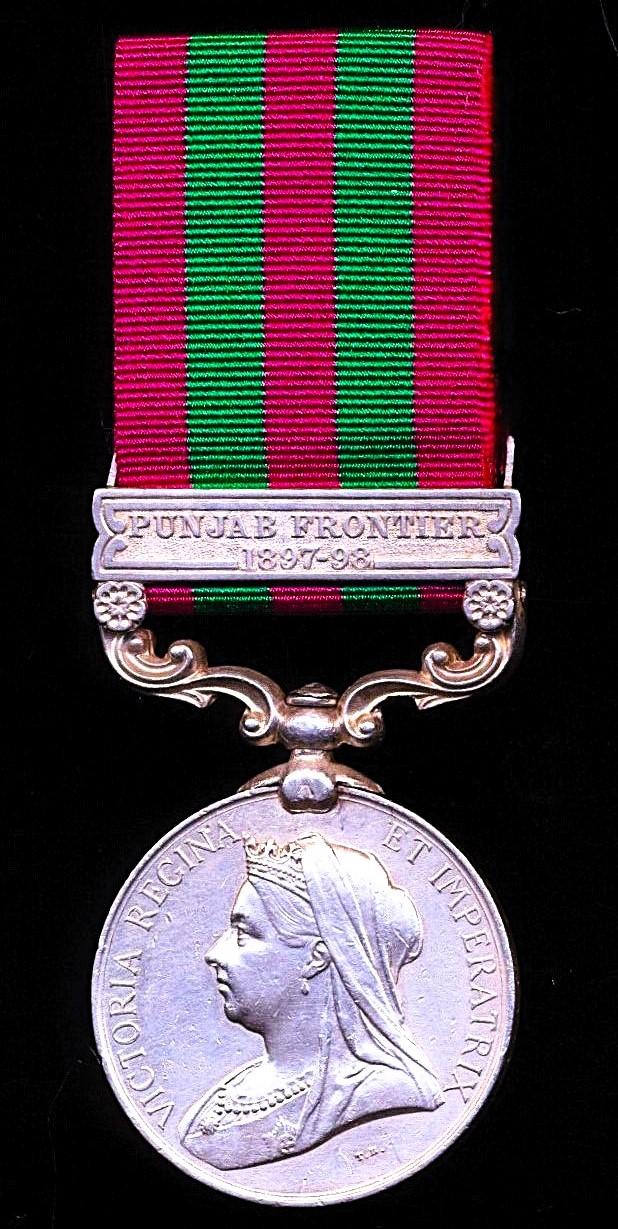
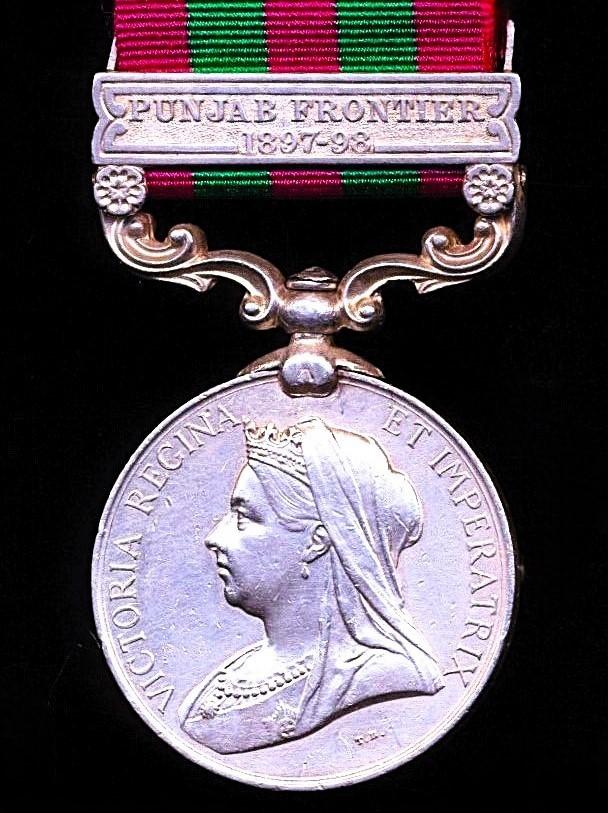
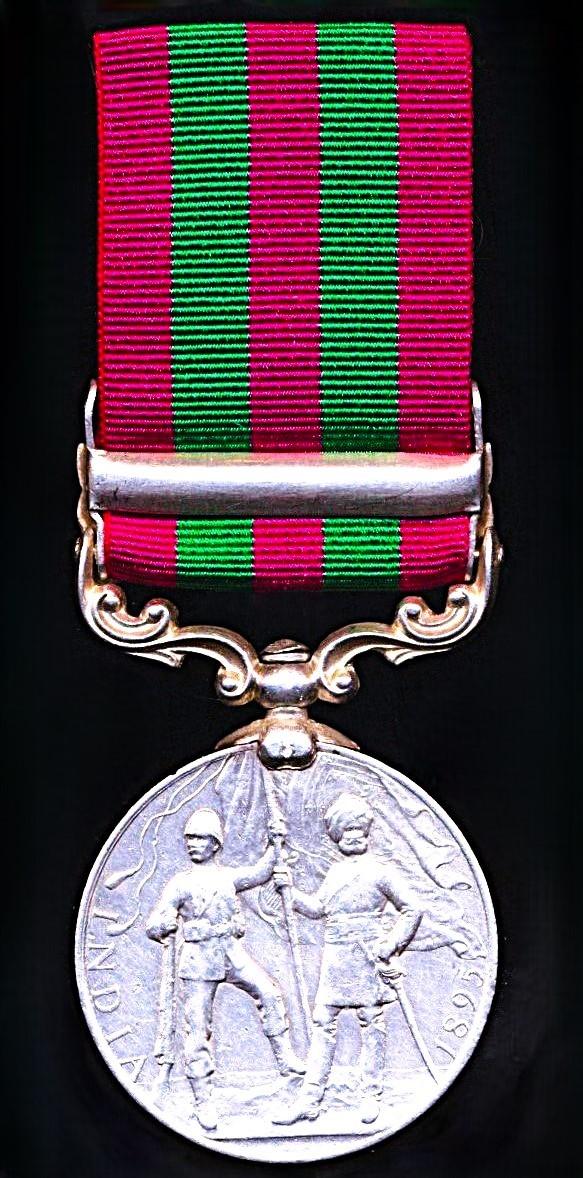
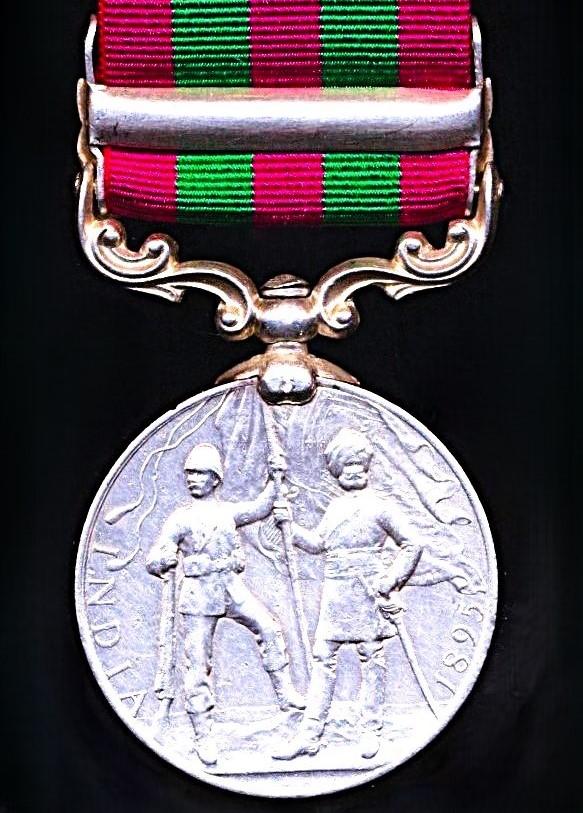
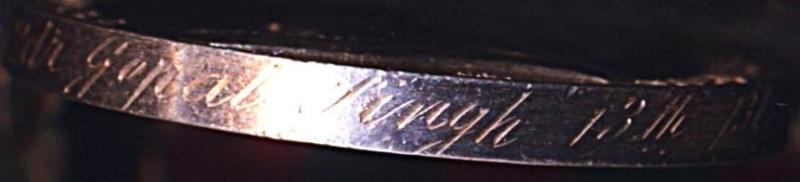
India General Service Medal 1895-1902. Victoria, silver issue with x clasp 'Punjab Frontier 1897-98' (145 K Duffdr Gopal Singh, 13th Bl Lcrs)
By ethnicity and faith the recipient Gopal Singh was a Dogra of the Hindu faith, who held the rank of 'Kote-Duffadar (Squadron Sergeant-Major / Sergeant Quartermaster) while serving with the 13th (The Duke of Connaught's) Regiment of Bengal Lancers, a cavalry regiment of the British Indian Army
A Kote-Duffadar was the highest attainable NCO rank in Indian Cavalry regiment. With one 'Kote-Duffadar' per 'Troop' (a typical Cavalry regiment comprised 4 x Squadrons with each Squadron having 2 x 'Troops'). Kote-Duffadars often had direct oversight of the respective 'Troops' equipment, stables, weapons (armory), and quartermaster stores. They were responsible for maintaining high standards of discipline, equipment readiness, and as drill instruction.
Per the Indian Army List issue of April 1897, the class composition of the 13th Bengal Lancers was:
- 1 ½ Squadrons 'Sikhs'
- 1 Squadron 'Dogras'
- 1 Squadron 'Punjabi Muhammadans'
- 1/2 Squadron 'Pathans'
13th Bengal Lancers: The regiment had its origins in 1858 when it was raised as the 4th Regiment of Sikh Irregular Cavalry, a unit raised at the time of the Indian Mutiny (1857-1859) by Lieutenant H C Catley and Lieutenant J Watson. The regiment served in the 2nd Afghan War (1878-1880) and the Egyptian War in 1882, gaining the battle honour, 'Tel-el-Kebir'. With Prince Arthur, Duke of Connaught, as an admirer and its new colonel-in-chief, the regiment became the 13th (Duke of Connaught's) Regiment of Bengal Lancers in 1884.
The unit became the 13th Duke of Connaught's Lancers (Watson's Horse) in 1904 and served in Mesopotamia during World War One (1914-1918). It returned to India and served in the 3rd Afghan War (1919) and in Waziristan. In 1922 it was amalgamated with the 16th Cavalry to become the 6th Duke of Connaught's Own Lancers in 1922
Condition: GVF
Code: 26078
175.00 GBP