


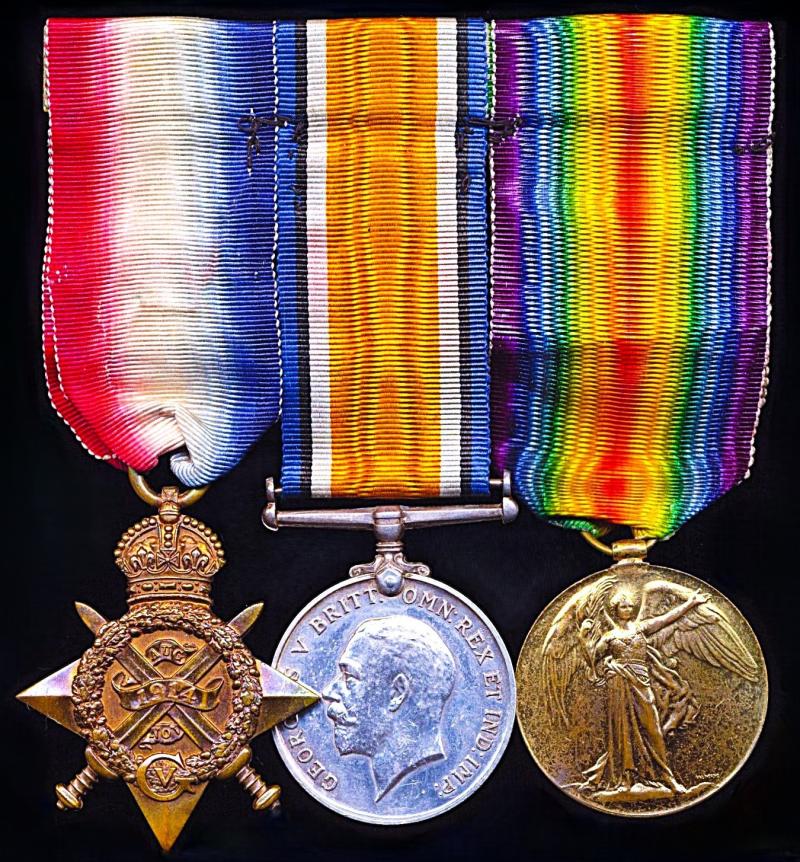
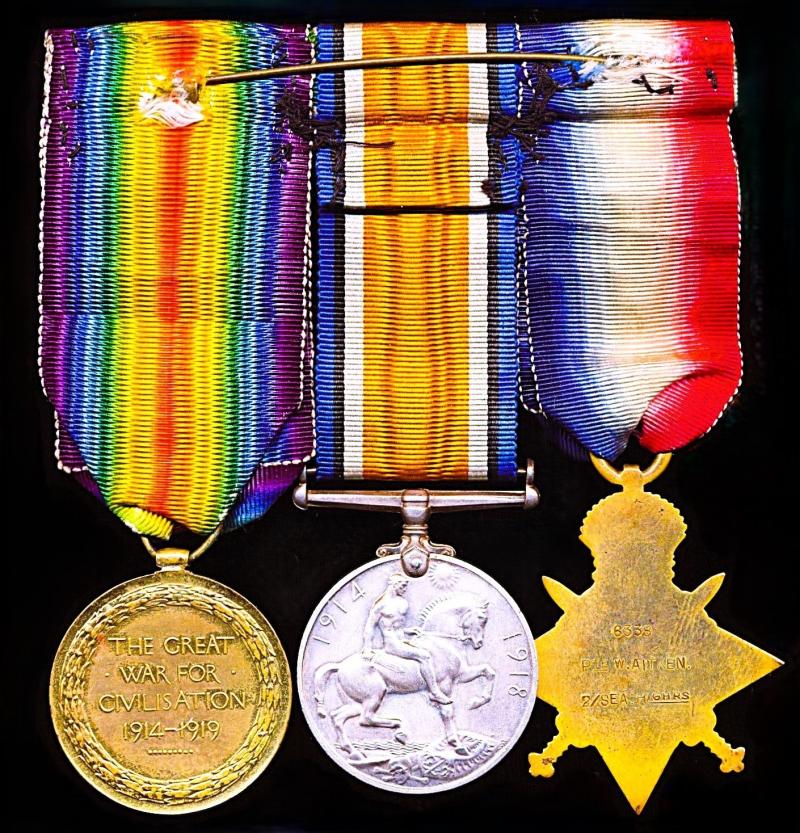
A Dunbar / Haddington interest 'Old Contemptible' casualty 'Shot in the Jaw' at Messines, medal group of 3: Private William Sheriff Aitken, 2nd Battalion Seaforth Highlanders (Ross-shire Buffs, The Duke of Albany’s)
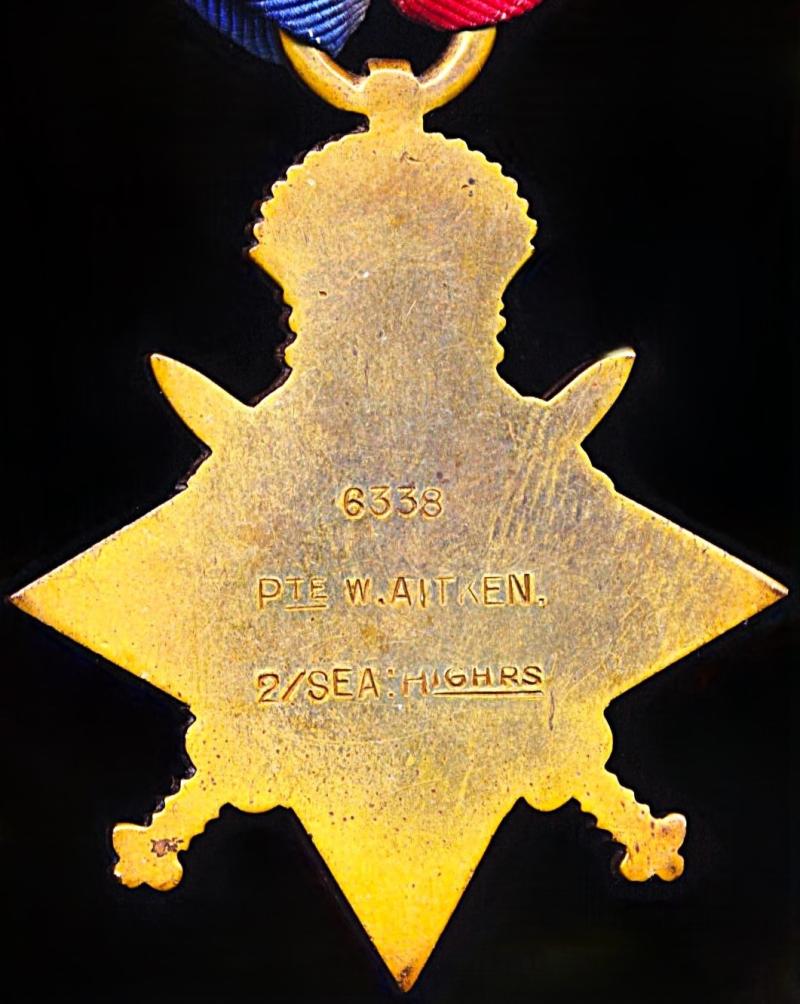
- 1914 Star. No clasp (6338 Pte. W. S. Aitken. 2/ Sea: Highrs.)
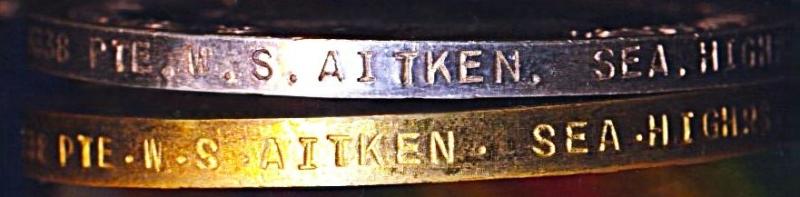
- British War Medal. Silver issue (6338 Pte. W. S. Aitken. Sea: Highrs.)
- Interallied Victory Medal (6338 Pte. W. S. Aitken. Sea: Highrs.)
Wounded in Action: Severe 'Gunshot & Shrapnel Wounds; (GSW) to 'Head (Jaws & Roof of Mouth) - leaving mark of 'Bullet wound through Jaws' at Messines 9 April 1915 - evacuated to United Kingdom 17 April 1915, and discharged from 'B' Company, 3rd Battalion Seaforth Highlanders, at Cromarty, Scotland, as a consequence of the severity of his wounds on 24 November 1915
At time of his discharge his distinguishing marks entered in his discharge papers say;
Quote,
Scar rt hip, mark of bullet wound through jaws
Unquote.
Medals & Clasps Verification: All Great War medals confirmed as entitled, together with two earlier QSA & KSA medals and clasps awarded to the recipient for his servicein the South African War. All of his medals were awarded for service with 2nd Battalion Seaforth Highlanders, per below referenced medal rolls:
- QSA & 5 clasps 'CC, PA, DR, TR & WIT': WO 100/203
- KSA Medal. With both SA dated clasps: WO 100/343
- 1914 Star: WO 329/2474 Disembarked France 15/09/1914
- British War Medal. Silver issue: WO 329/1644. Shows served 2/Seaforth
- Interallied Victory Medals: WO 329/1644. Shows served 2/Seaforth
William Sheriff Aitken, was the eldest son of John Porter Aitken (a House Painter ) & Elizabeth Aitken (nee Sheriff) was a native of Dunbar, Haddingtonshire, Scotland, where he was born on, 22 August 1879. William was of three children in the Aitken family, the other siblings being: An older half-sister, Ellen Sinclair Aitken (b.1875) & younger brother, Richard Aitken (b.1880). By the time of the compilation of the 1891 National Census for Scotland, the family had relocated from Dunbar to North Berwick, East Lothian, where they resided at an address on Forth Street.
On, 22 October 1898, William Sheriff Aitken enlisted in his local town, North Berwick, for the British Army, on which date he was posted to the Seaforth Highlanders, and given the regimental number 6338. At enlistment William declared himself as having been a 'Painter' by trade, and that he was 19 years & 9 months of age. He also cited prior military service as a member of the 7th Volunteer Battalion Royal Scots. On 21 August 1899 he was posted to the 2nd Battalion Seaforth Highlanders. Willaim had enlisted under the standard 'Short Service' contract of 7 Years with 'The Colours' and 5 years with the 'Army Reserve' to complete 12 years service, and during that time his summary of service was:
- Home: 22/10/1898 - 02/01/1900
- South Africa: 03/01/1900 - 15/12/1902
- India: 16/12/1902 - 11/01/1907
- Home: 12/01/1907- 21/10/1910
During his first period of service, he had nominated his younger brother, Richard Aitken as his nominated next of kin, who at the time was residing at, 36 Wilham Street, Edinburgh, Scotland. At discharge William indicated that his future intended place of residence was, 12 Dean Park Street, Edinburgh, Scotland - this being the residence of his married sister, Mrs. Ellen Westwater
After completion of his first period of service, William had agreed to continue his service with the Army Reserve, and on 25 November 1911, extended his service with the Army Reserve for another 4 years - under what was called 'Section D Army Reserve'. On his return to civilian life in 1910, William obtained a job as a 'Billiard Marker', and no doubt by virtue of his work would have been a 'well kent' face in 'Edinburgh Toon' in the pre-war years 1910-1914
As a consequence of being a Section D Reservist, William was re-called to 'The Colours' on the outbreak of the Great War in August 1914. On 5 August 1914 William was mobilized at Fort George, near Inverness where he joined his old corps, briefly joining 3rd Battalion Seaforth Highlanders from 8 August 1914, before being posted to his former battalion, 2/Seaforth on 13 September 1914, as part of a reinforcement draft of 'Reservists' embarking for France. William is recorded to have disembarked in France on 15 September 1914. Neither the recipients Medal Index Card or 2/Seaforth medal roll for the 1914 Star show that he was entitled or claimed a dated clasp to his 1914 Star, but what is certain is that Private Aitken did subsequently serve in the thick of the fighting in France & Flanders, as evidenced by being severely wounded-in-action at the Battle of Messines on 9 April 1915, whereat he was wounded through the jaws and roof of mouth by a bullet!. Such was the severity of his battle wounds that he was medically evacuated from Boulogne, France, on 18 April 1915. He never again returned to the field of battle!
William Sheriff Aitken took his final discharge from the British Army at Cromarty, Scotland on 24 November 1915, cause of discharge was 'Being no longer physically fit for further military service'
William Sheriff Aitken, the veteran Seaforth Highlander of two wars, is recorded to have died in Edinburgh, Scotland on 7 May 1938
The recipients service papers - very good sets - are extant and accessible at The National Archives
The medals are mounted on a medal bar in the swing-style, and as-worn by the recipient. The medals are suspended from silk 'moire' ribands on a contemporary white-metal mounting bar that retains its long hinged pin & clasp fittings
Condition: About GVF
Code: 26108
165.00 GBP