


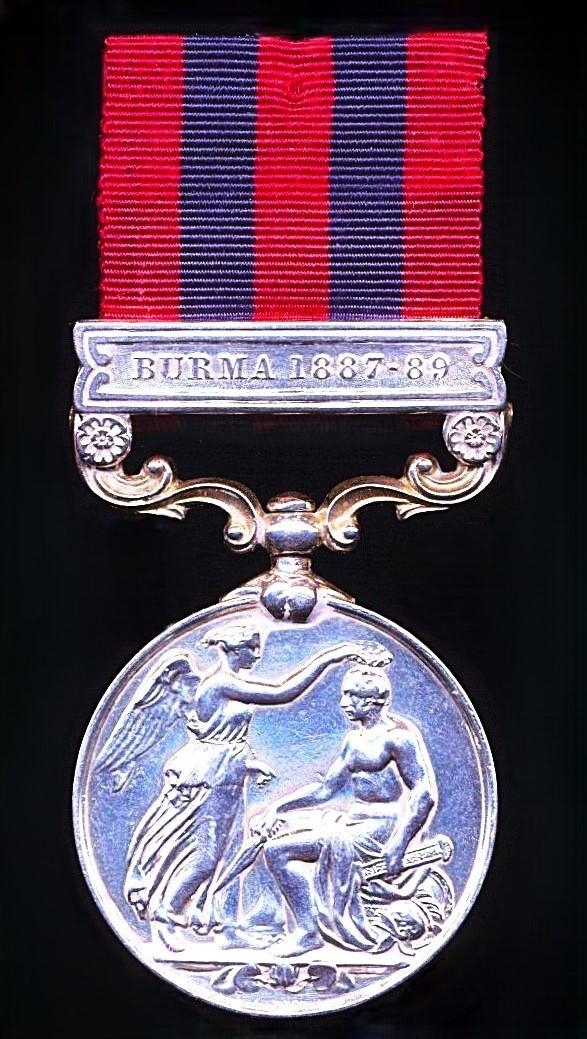
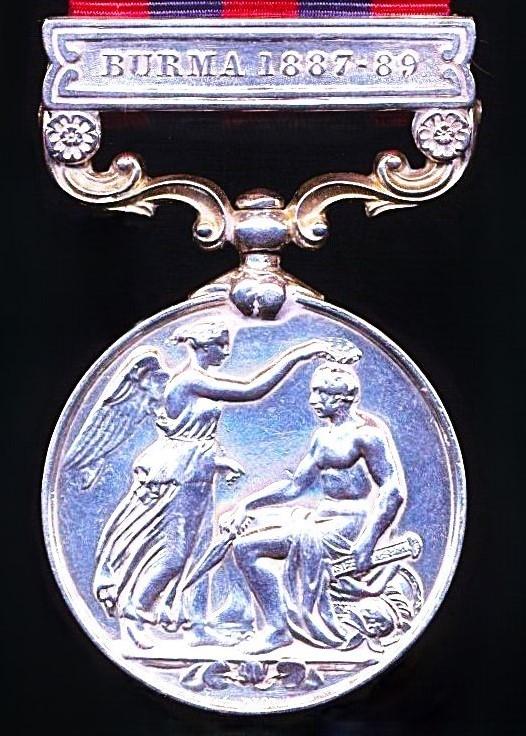
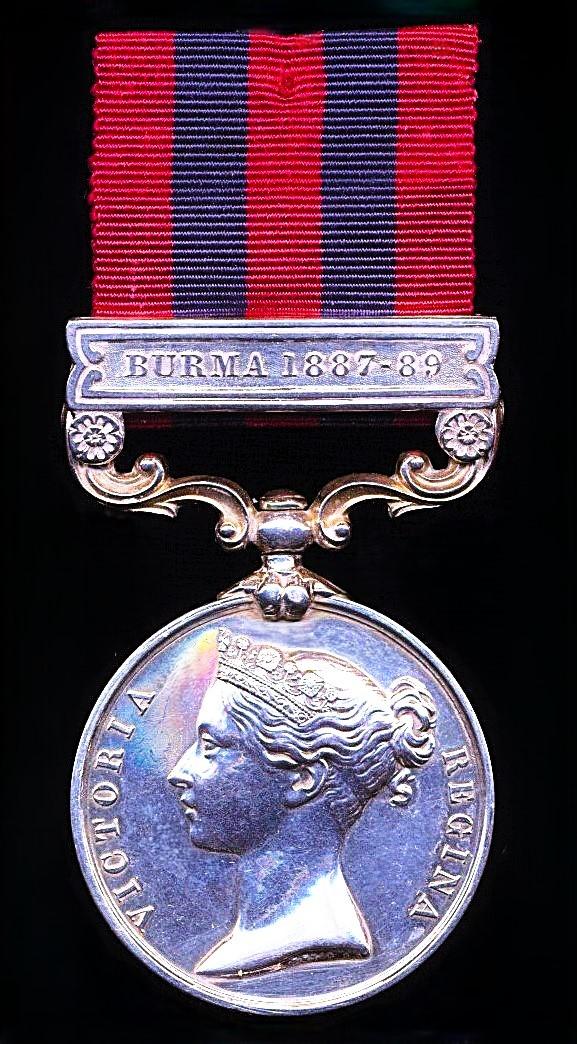
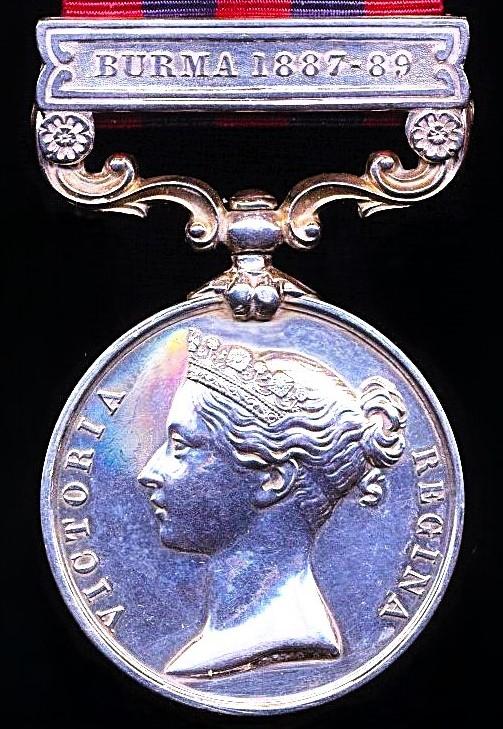
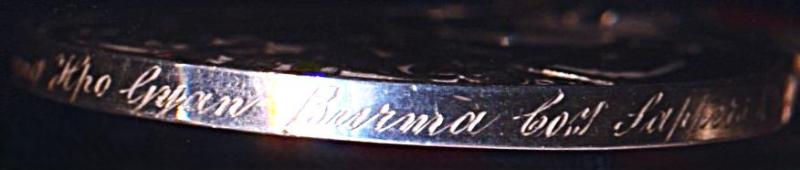
India General Service 1854-95, 1 clasp, Burma 1887-89 (107 Sapper Moung Hpo Gyan Burma Coy. Sappers & Miners)
By ethnicity the recipient Muong Hpo Gyan, was a native Burman of the Buddhist faith, who held the rank of 'Sapper' while serving with 'The Burma Company Sappers and Miners' a single company strength unit of the corps of Queens Own Madras Sappers and Miners of the Madras Presidency Army of the British Indian Army
The Burma Sappers and Miners were raised in 1887, they were initially referred to as the Burma Company Sappers & Miners, and were included as a separate formation under the regimental listings for the Queens Own Madras Sappers & Miners that were published in the Indian Army Lists prior to 1903. The unit had the distinction of being the very first regular military unit raised in Burma to recruit and eventually comprise only Burmese indigenous soldiers, under command of British Officers. The other-ranks were drawn from several classes and ethnicities including, Burmans, and the Karen, Kachin and Shan hill tribes. Reference the monumental 'The Military Engineer in India' Volume I (E.W.C. Sandes, 1933), the author writes:
Quote,
One result of the war was the raising of a Burma Company of Sappers and Miners. This was authorized in July, 1887, and the unit was affiliated to the Madras Sappers and Miners. The Royal Engineer officers for the new unit were to be lent in rotation from the three Corps of Sappers and Miners, each officer being relieved after two years in Burma if he so desired. The Indian officers were to come solely from the Madras Corps. Great difficulties were encountered at once in getting recruits, only 15 of whom had enlisted by the end of 1887 when the company at Mandalay was commanded by Captain E.W Cotter, R.E. The first idea had been to form a unit of one half of which should be Burmans, one-quarter Kachins and Karens, and one -quarter Shans; but the Kachins and Shans would not come forward, and when the company reached its full strength for the first time in October, 1890, about four-fifths of the men were Burmans and the remainder Karens. In 1893 the Burma Company became an integral part of the Corps of Madras Sappers and Miners, rendering good service for a number of years until it was finally disbanded in 1929. Many officers have pleasant recollections of the jovial and intelligent Burma Sapper in his slouch hat and smart uniform in modern Mandalay.
Unquote
Per the regimental listing of the Queen's Own Madras Sappers & Miners in the Indian Army List of January 1890, the composition (less 'Followers') of 'The Burma Company of Sappers and Miners who were located at Mandalay (Upper Burma) was:
- Company Commander: x 1
- Company Officer: x 1
- Company Sergeant-Major: x 1
- Sergeant: x 1
- Subadar: x 1
- Jemadars: x 6
- Naicks: x 10
- Sappers: x 150 (by ethnicity 50% Burmans; 25% Shans; 25% Kachins & Karens)
- Bugler: x 2
- Interpreter: x 1
For a single company size, the unit was extensively deployed on active service campaigns in Burma between 1889-1894, earning several clasp issues of the Indian General Service Medal 1854. Various issues of the London Gazette, and the Calcutta published 'The Englishman's Overland Mail' (and subsequent issues of The Englishman) in the period circa 1887-1895, contain reports of the engagements - and casualties sustained - by the Burma Sappers & Miners in that period
In 1903 the unit was restyled as 15 (Burma) Company, 2nd Queen's Own Madras Sappers and Miners, becoming 4th Burma Sappers and Miners in 1922 (in which year the unit was decoupled from any further association with the Queens Own Madras Sapper & Miners. The unit was again finally styled Burma Sappers and Miners in 1923. The unit was disbanded in 1929
A rare medal to find on the market named to a Burman soldier of the 'The Burma Company Sappers and Miners'
Condition: GVF
Code: 26160
250.00 GBP