


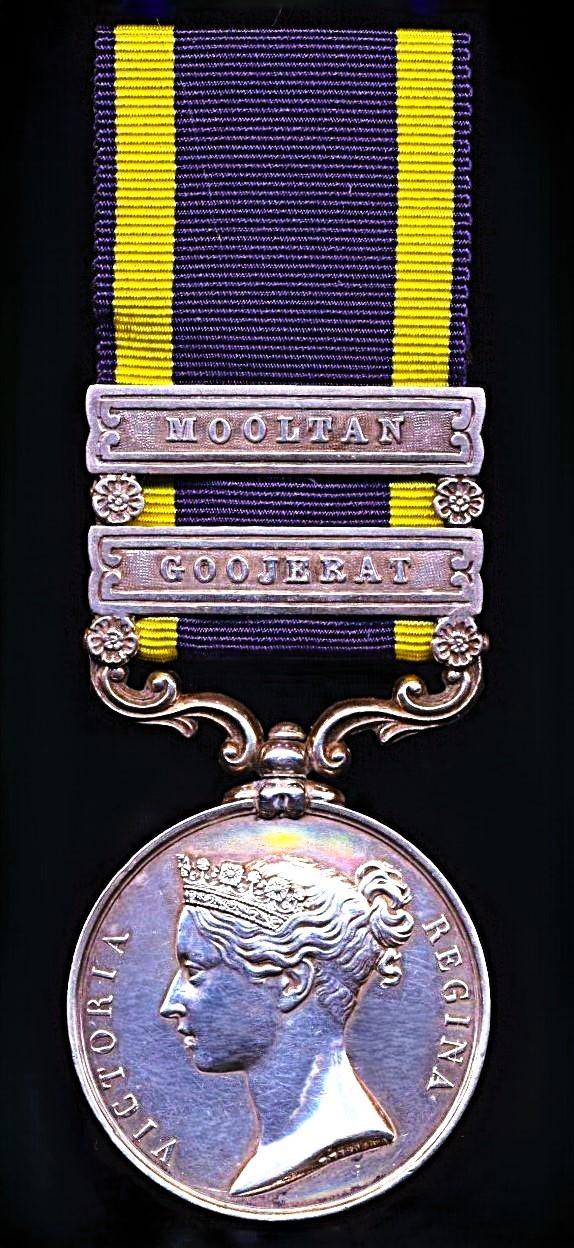
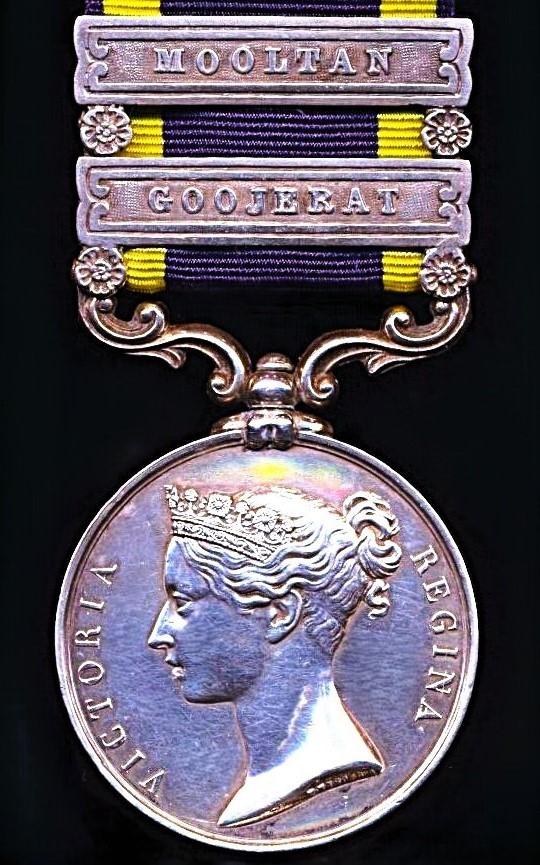
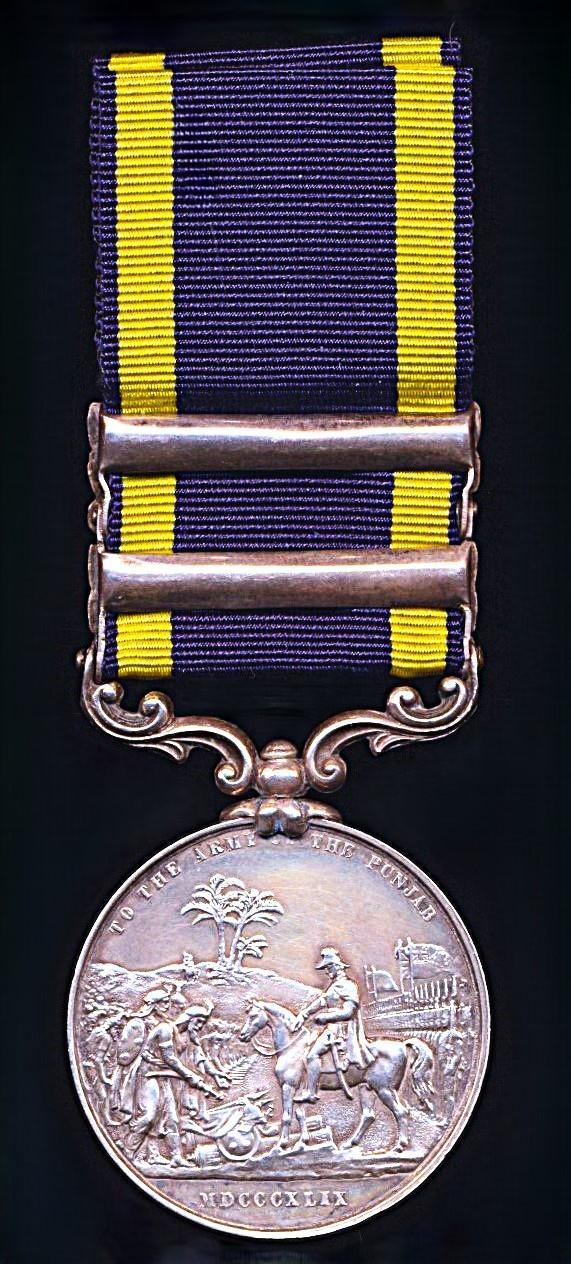
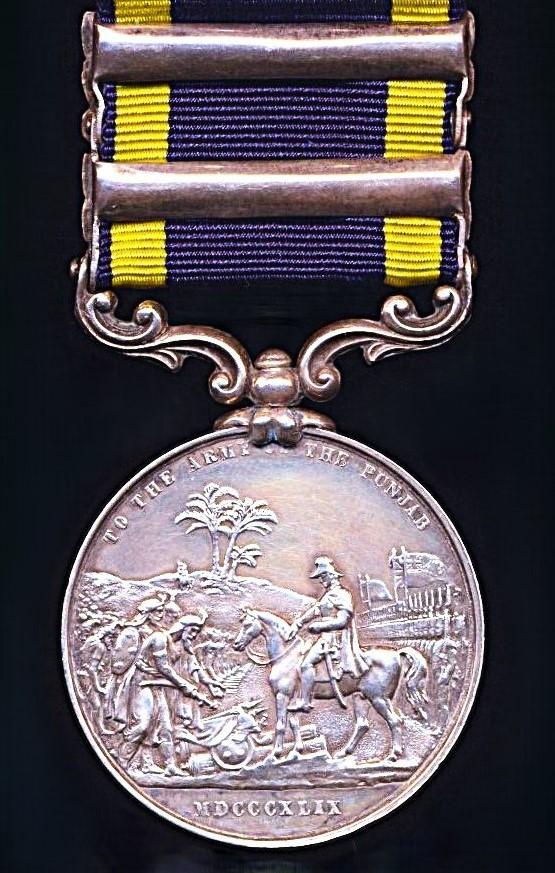
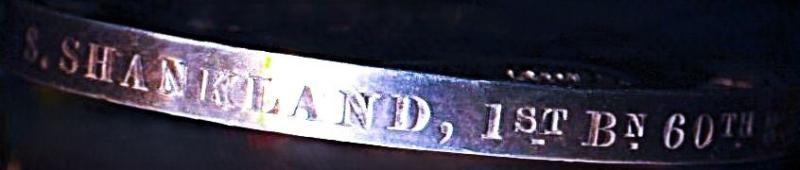
Punjab Medal 1848-49. With 2 x clasps 'Goojerat' & 'Mooltan' (S. Shankland, 1st Bn 60th R.Rifles.)
Died-of-Wounds: No 2775 Private Samuel Shankland, 1st Battalion 60th Rifles is confirmed being 'Wounded-in-Action' on 23 June 1857 (London Gazette issue of refers) and subsequently 'Died of Wounds' 12 September 1857 (London Gazette
Witness to the Outbreak of the Indian Mutiny. Meerut Cantonment: Private Shankland, a long serving professional soldier who had enlisted in the British Army sometime before 1841, appears to have been approaching his milestone 21 years 'service with the colours' - and imminent retirement - when the maelstrom of the 'Great Mutiny' broke out at the massive Meerut Cantonment in Northern India, located just over 40 miles from Delhi. Famously on the day of the outbreak of the Mutiny, Sunday 10 May 1857. the men of the 60th Rifles were preparing for attending evening Sunday prayers at St. John's Garrison Church located in the European Lines - while the 60th Rifles were gathering un-armed for church, European and Eurasian all-ranks and civilians were being slaughtered in the Indian Lines, by Bengal Army mutineers. Un-armed as they were, once the emergency was realised, the 60th Rifles, including Private Shankland, had to be marched back to their barracks to gather their arms and draw ammunition, before they could the engage the rampaging mutineers
'The Centenary Battle', Delhi Ridge 23 June 1857: On the fateful day that he was wounded-in-action, Samuel Shankland was serving with his battalion on Delhi Ridge, where the 60th Rifles, together with the Sirmoor Rifles (later 2nd Gurkha Rifles) and the nearby Corps of Guides held the main forward piquet positions at and near Hindu Rao's House. The rebels considered, 23 June 1857 a propitious day, to launch a massive attack against the British Force on Delhi Ridge, as it would mark exactly 100 years between the Battle of Plassey, and the end of British rule in India. In the final reckoning 6000 rebels launched a series of attacks, over 12 hours of savage fighting before being successfully repulsed by the Delhi Filed Force. During day's fighting, the rebels suffered loses of an estimated 1000 men, killed & wound while the British 'Delhi Field Force' incurred an estimated 160 casualties, killed & wounded (including Samuel Shankland)
Although the exact nature of Samuel Shankland's wounds on 23 June are not known (they were blandly described as 'Slightly Wounded' in the published casualty return) they were clearly of a serious enough nature, that just over 11 weeks later he was returned as having 'Died-of-Wounds' at Delhi Ridge on 12 September 1857. Evidently considered not safe enough to be evacuated form the British position at Delhi after 23 June, the wounded soldier had to endure lingering suffering through the high heat of Summer, and the ever present danger of rebel attack and or disease before he succumbed, in a distant war-torn land far from his native home in Ayrshire, Scotland
A Victoria Cross was awarded to Colour-Sergeant John Garvin 60th Rifles for his conspicuous gallantry at Delhi on, 23 June 1857. As context to Garvin's award the website of the 'The VC & GC Association', states:
Quote:
The centenary of the Battle of Plassey fell on 23 June 1857 and there was a widespread belief in India that British rule would end on that day. The mutineers chose it to mount another attack on the rear of the British position. They advanced through the Sabzi Mandi, to the south-west of the Ridge, threatening the Mound Battery to the north, which protected the British camp, and Hindu Rao’s House on the Ridge itself. The British cleared the streets of the Sabzi Mandi three times but on each occasion the mutineers reoccupied them. Fighting continued all day but the British eventually prevailed, strengthened by the arrival at Delhi earlier in the day of reinforcements under Major W Olpherts VC. A picket was posted in Sabzi Mandi to prevent further rebel incursions through it. In the fighting that day Colour Sergeant Stephen Garvin, 60th Regiment, led an attack on the Sammy House (a corruption of Swami House or Temple), on the City side of the southern end of the Ridge....
Unquote
Colour-Sergeant Stephen Garvin's citation for the Victoria Cross was published in the London Gazette issue of 20 January 1860:
Quote,
For daring and gallant conduct before Delhi on the 23rd of June, 1857, in volunteering to lead a small party of men, under a heavy fire, to the “Sammy House,” for the purpose of dislodging a number of the Enemy in position there, who kept up a destructive fire on the advanced battery of heavy guns, in which, after a sharp contest, he succeeded. Also recommended for gallant conduct throughout the operations before Delhi.
Unquote.
Medals & Clasps Verification: Private Samuel Shankland 1st Battalion 60th Royal Rifles (in 1881 regiment re-styled King's Royal Rifle Corps) is confirmed entitled to below medals and clasps per respective cited medal rolls:
- Punjab Medal 1848-49, with clasps 'Goojerat' & 'Mooltan& 2 X CLASPS : L/MIL/5/71
- Indian Mutiny Medal 1857-58, with clasp 'Delhi: WO 100/37
Whether the Indian Mutiny Medal with clasp 'Delhi' was ever subsequently forwarded or claimed by Samuel Shankland's family, or if the medal was returned to the Royal Mint for eventual scrapping is not currently known
Samuel Shankland son of James Shankland and Christian McMeekin (sp) was a native of Girvan, Ayrshire, Scotland, where he was born on 16 July 1817, and where he was baptised on 10 August 1817. Samuel enlisted in the British Army sometime before 1841, as in 1841 he is recorded serving in country Jamaica, (with location at sea, Jamaica, indicating he was in-transit to Jamaica) at which time he held regimental number 1334 with 2nd Battalion Royal Rifles (British Army Worldwide Index 1841, drawn from Muster Rolls of April & June refers, see file series WO 12/6962). 2/60 Rifles served in the West Indies - primarily at Jamaica - between 1841-1844. Sometime after his service in the Caribbean, Samuel Shankland was transferred to the 1st Battalion 60th Rifles, at which time he was allocated a new regimental number vis No, 2775. 1st Battalion 60th Rifles was stationed at various cantonments in British India between 1845-1860, during which time the 1/60th Rifles, together with Private 2775 Samuel Shankland saw active service in the Second Anglo-Sikh War 1848-49 (gaining battle honours for Goojerat & Mooltan'). The British Army World Wide Index for 1851, shows Samuel Shankland serving in India, at which time the 1/60th had detachments located at the Cantonments of Kussowlie & Jalanadhar during the period 01/01/1851-31/03/1851 ((British Army Worldwide Index 1851, drawn from Muster Rolls of first quarter refers, see file series WO 12/6909)
A hard earned medal, to a much travelled professional soldier who after witnessing the outbreak of the Indian Mutiny, subsequently served on Delhi Ridge where he lost his life
Condition: GVF
Code: 26170
750.00 GBP