


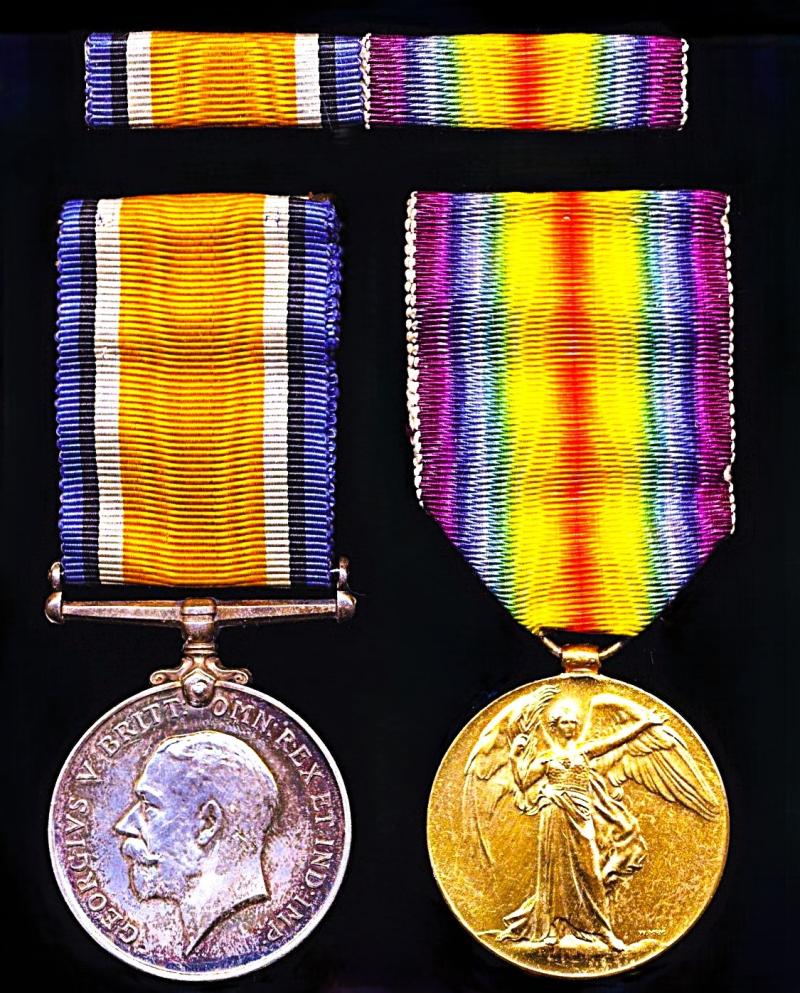
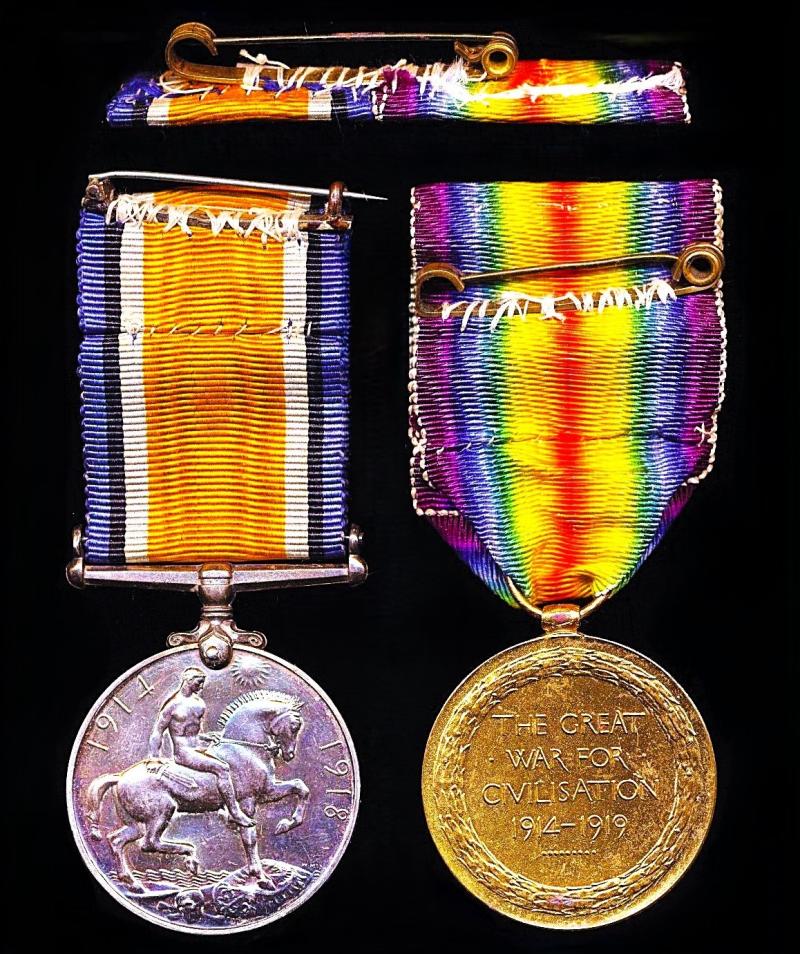
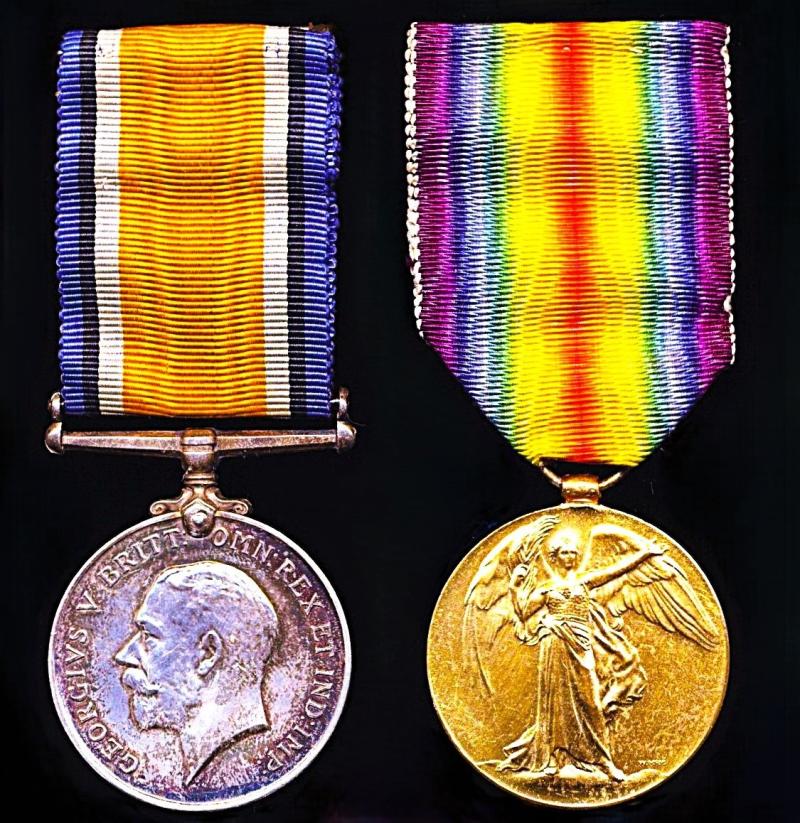
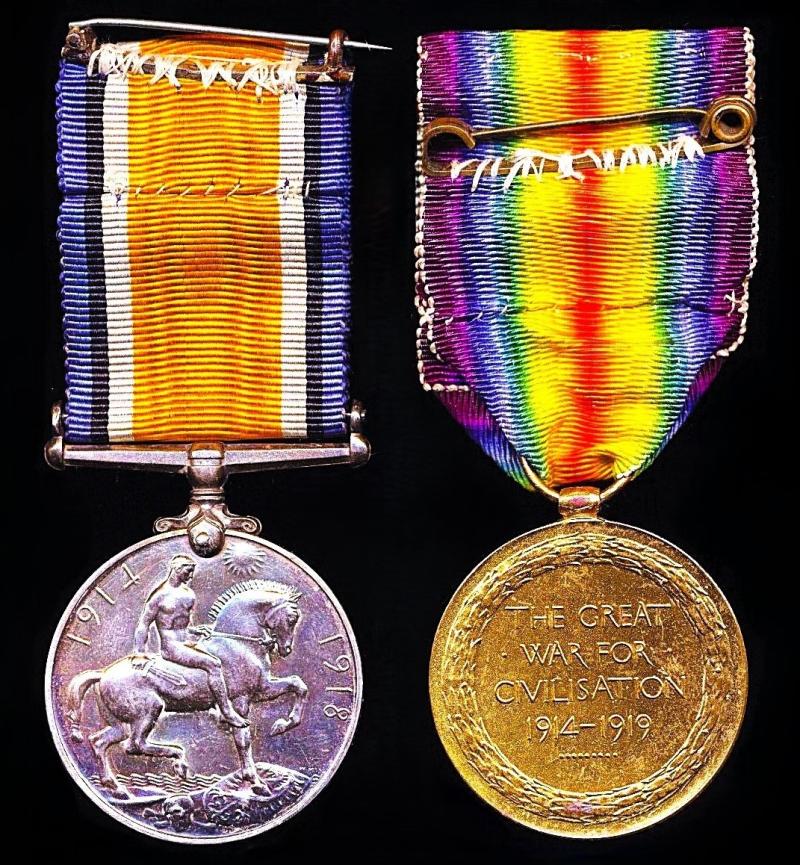
A Life-Guards / Great Western Railway / Wootton Bassett /Wiltshire interest Great War 'Gassed on the Western Front' medal pair: Trooper Henry 'Harry' Leonard Brust 1st Household Battalion, formerly 2nd Life Guards & latterly Coldstream Guards
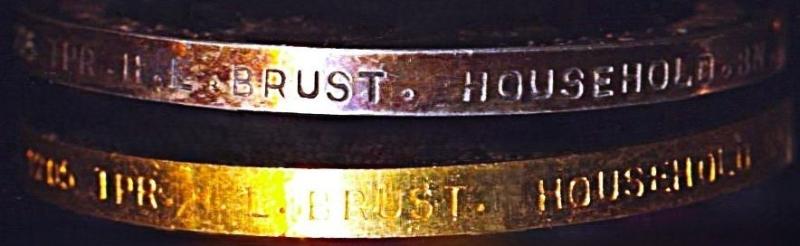
- British War Medal. Silver issue (1205 Tpr. H. L. Brust. Household Bn.)
- Interallied Victory Medal. (1205 Tpr. H. L. Brust. Household Bn.)
Sold together with:
- Companion contemporary 2 x space medal riband bar. This with stitched reverse & a brass hinged pin
Medals Verification: Both Great War medals confirmed as the recipient's full medal entitlement per the respective campaign medal roll referenced below:
- British War Medal: WO 329/195 Coldstream Gds Roll prior 1205 Trooper 1st Household Bn
- Interallied Victory Medal: WO 329/195 Coldstream Gds Roll prior 1205 Trooper 1st Household Bn
Household Battalion: The Household Battalion was an infantry battalion of the British army during the Great War. It was formed in September 1916 at Knightsbridge Barracks, London, from the reserves of the Household Cavalry regiments (the 1st Life Guards, 2nd Life Guards and the Royal Horse Guards) to help fill the ever-increasing demands for infantry on the Western Front. Considerable effort was expended in the conversion of cavalrymen into infantry trained and equipped for trench warfare. The battalion spent its entire existence on the Western Front as part of the 4th Infantry Division, arriving as the Battle of the Somme was ending in November 1916. It remained in the Somme Sector through to Spring 1916, when it fought in the Battle of Arras and later at Third Ypres, suffering severely in the assault on Poelcappelle. Its last major engagement was the defence of Bourlon Ridge during the Battle of Cambrai in late 1917. By this time, it had become apparent that there were insufficient reserves to support all the Household Cavalry regiments that had been converted to infantry (in particular, the Guards Machine Gun Regiments) and it was disbanded as part of a general reorganization in February 1918
Henry 'Harry' Leonard Brust, a 'Railway Clerk' first enlisted in the British Army on 3 November 1915, at Windsor, England, when he was posted to the 2nd Life Guards, a cavalry regiment of the Household Cavalry. While serving with the 2nd Life Guards, and when subsequently transferred to the Household Battalion, 'Harry' held the rank of Trooper. 'Harry' first entered theatre of war 'France' with the Household Battalion on 8 November 1916, and remained on active service with the British Expeditionary Force on the Western Front through to 12 March 1917. After being gassed by the enemy, 'Harry' was returned to the United Kingdom, and did not again return overseas. On return to the United Kingdom 'Harry' was transferred to the Reserve Household Battalion, with which unit he remained until being transferred to the Coldstream Guards on 14 February 1918. Holding the appointment of Lance-Corporal, 'Harrt' Brust, took his final discharge from the British Army at Fovant, Wiltshire, England on, 25 February 1919 when he was transferred to the Class Z Reserve on demobilization. At discharge his residence address was, 157 High Street, Wootton Bassett (his mother lived at 'Aston Villa;, Wootton Basset)
Henry 'Harry' Leonard Brust was the eldest son of Henry Anthony Brust (in 1911 a Railway Accountants Clerk with North Western Railway, at Wootton Bassett) & Jane Brust (nee Kilpin) was a native of Fulham, London, England where he was born on 19 August 1893
The North Wilts Herald newspaper issue of 26 July 1935, contained the below following interesting obituary:
Quote,
SWINDON DEATH
The death has taken place of Mr Harry Leonard Brust, aged 41, of 159, Goddard-avenue, Swindon. He spent many years in the Swindon G.W.R. Works as a Clerk in the loco department. He joined the Army in 1916, serving in the 2nd Lifeguards and the Coldstream Guards.
Mr Brust was gassed on the Somme and invalided home, where he was transferred to the Household Brigade of Guards. In 1921 he went to Cuba as a clerk, and the year after worked in Toronto, also as a clerk, returning to Swindon in 1927. Owing to his war experiences, however, he became a permanent invalid. He died in Harnwood Hospital, Salisbury.
Mr. Brust, leaves a widow, Mrs. Ethel Brust, and one daughter.
Unquote.
The full-size medals each fitted with lengths of original bright silk 'moire' ribands. The ribands each stitched and fitted with contemporary pin & clasp fittings, and as-worn by the veteran
A desirable and scarce seen Household Battalion Great War medal pair
Condition: About EF
Code: 26178
140.00 GBP