


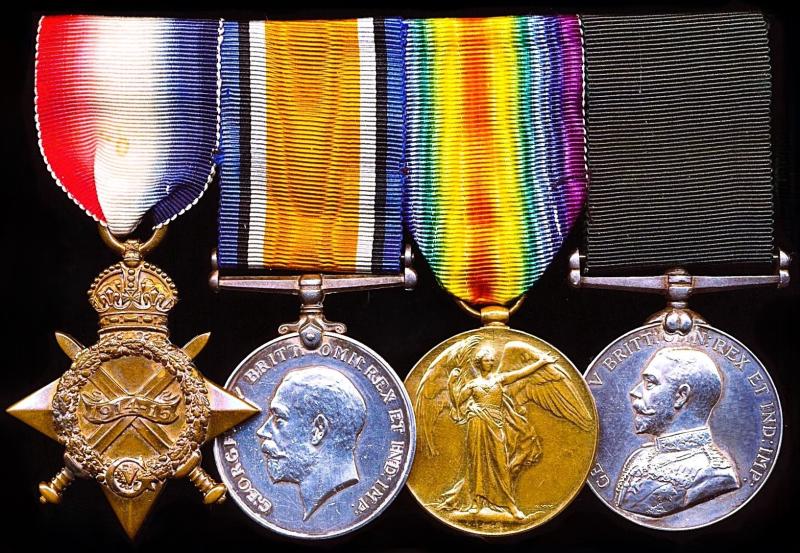
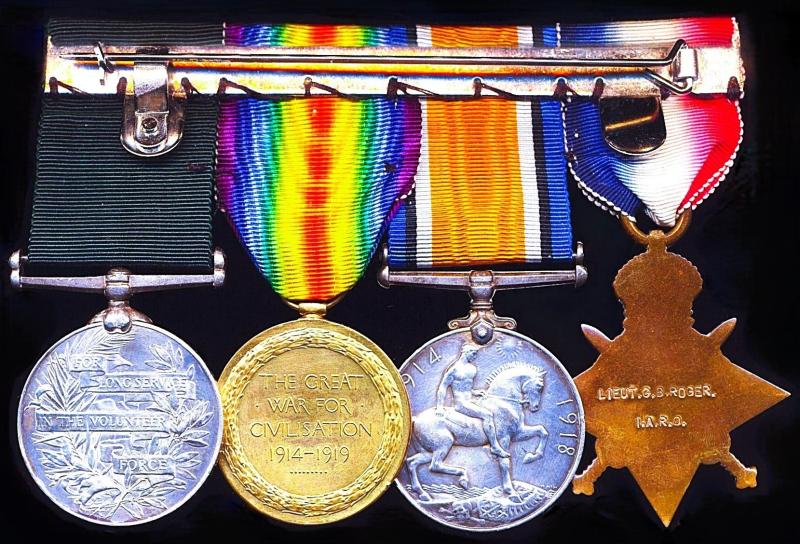

A 'Rangoon Volunteers' Great War medal group of 4: Captain George Bennett Roger, 3rd (Rangoon Port Defence) Group Garrison Artillery Indian Defence Force, late S. & T. C., I.A.R.O. & 1st Electrical Engineer Company Rangoon Port Defence Volunteer Corps
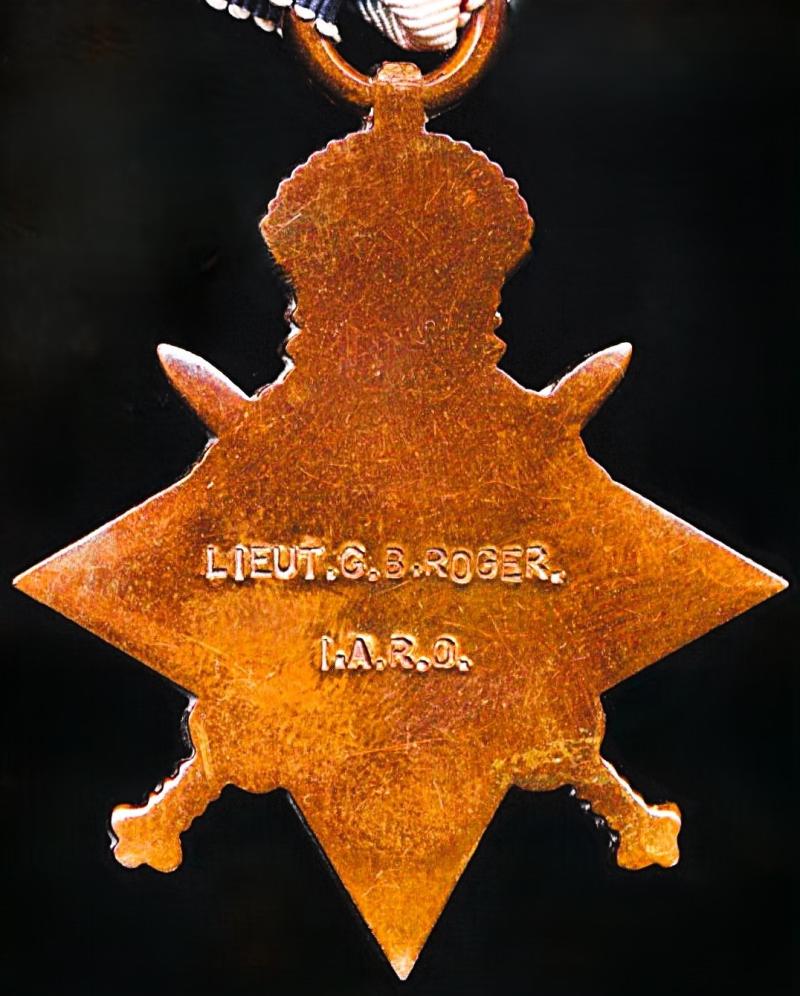
- 1914-15 Star (Lieut G. B. Roger. I.A.R.O.)
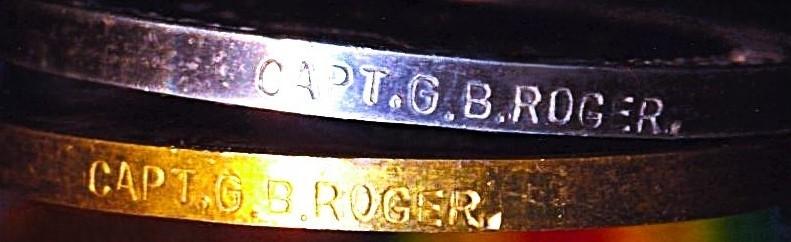
- British War Medal. Silver issue (Capt G. B. Roger.)
- Interallied Victory Medal (Capt G. B. Roger.)
- Volunteer LSM. GV (Captn. G. Bennett Roger, 3 (Rangoon Port Defence) Group Garr.Arty.I.D.F.)
Naming: The officially impressed naming on the Volunteer Long Service Medal (India & Colonies) takes up the entire rim of the medal - and impressive seen thus
Photographs of Recipient: The Aberdeen, Scotland, local newspapers of the 1930's - 1950's, published numerous articles including captioned photographs of Captain Roger
3rd (Rangoon Port Defence?) Group Garr Arty. IDF: Per the January 1921 Indian Army Quarterly Army List the unit was formed on 30 September 1892. It was reorganised by G GO 442 of 442 of 19 March 1905 and it was reconstituted as an IDF unit with the designation, 3rd (Rangoon Port Defences) Group Garrison Artillery on 1 April 1917. On 1 October 1920 it was re-designated as The Rangoon Port Defence Royal Garrison Artillery. In 1921 it consisted of one Active Company, two combined Active & Reserve Companies, and one Cadet Company (in 1919 there was also an Engineer Company). In January 1921 it had two officers and in April 1921 it had six officers
Medals Verification: All 4 x medals confirmed as entitled per the respective medal rolls and Indian Army authority cited below:
- 1914-15 Star: WO 329/2941. Medal roll dated India Office 17 November 1921
- British War Medal. Silver issue: WO 329/2348. Medal roll dated India Office 10 January 1922
- Interallied Victory Medal: WO 329/2348. Medal roll dated India Office 10 January 1922
- Volunteer Long Service Medal. GV: Awarded 2 August 1921 per Indian Army Order No. 842 of 1921
Rarity: Only 18 x VSLM's awarded to the 3rd (Rangoon Port Defence) Group Garrison Artillery of the Indian Defence Force) most awards being to 'NCO's and Other-Ranks' of the unit
There are 2 x respective Medal Index Cards for a Captain George Bennett Roger, both showing entitlement to the 1914-15 trio, the first showing his first rank and unit as Lieutenant Indian Army, and the latter as Royal Army Service Corps this last with theatre of war being entered as Egypt, September 1915. Both MIC's show final rank of Captain!
Officers Service Papers: Captain Rogers officers service papers are extant and accessible at The British Library in the file series IOR/L/MIL/14/60351
The January 1919 issue of the Indian Army Quarterly Army List shows George B. Roger as a Captain in the Supply and Transport Corps, IARO with a commissioning date of 12 February 1915 and attached to the S & T Corps on 22 February 1915. His present appointment is listed as a Supply & Transport Officer, 5th Class effective 16 July 1915. In the precedence list he is listed under 'Infantry Officers' as a Captain effective, 16 July 1915. was first commissioned on 12 February 1915. His Medal Index Card confirms that he first served overseas from India from served overseas attached to Supply and Transport Corps of the British Indian Army, including service in Salonika.
Post-war, when living and working in Aberdeen and the North East of Scotland, as a Manager for Dunlop Rubber, Captain Roger established the Aberdeen Salonika Veterans Association - and was equally involved with the wider activities of the Salonika Veterans Branches throughout Scotland in the inter-war years
On his return to the United Kingdom, Captain George Bennet Roger, resided at 'Maymyo' Edgehill Road, Aberdeen, Scotland. He is recorded as having died in Aberdeen on 19 April 1963
Evening Express issue of 16 May 1956:
Quote,
BACK TO BURMA AND BENGAL
The well-known Rotarian and former manager of a Rubber Company, Mr. George Bennett Roger, Maymyo, 2 Edgehill Road, is at present on holiday with Mrs. Roger in the east.
The object of the holiday, Mr. Marcus Milne, city librarian, told me yesterday, was to renew his acquaintance with his many friends in Burma - and with the country as well, for he worked there before World War I.
Mr and Mrs Roger have also been to Ceylon and India. While in India they went to Calcutta; and when in Calcutta they decided to go on and visit Darjeeling, high up on the Bengal-Nepal border, where many Europeans go during the summer to escape the oppressive heat of India at sea level.
And from Darjeeling, Mr and Mrs Roger made a short excursion to nearby Kalimpong which is right on the frontier and whose main claim to fame these days is that it is the home of the illustrious Sherpa Tensing.
STAMPS STOLEN
The made a point of calling on Tensing, met his wife and two daughters, and were shown some of his Everest kit.
Both Mr and Mrs Roger formed the highest opinion of the great climber, who is now a big noise with a large house, car, and so on, given him in recognition of his achievement.
Despite it all, there is not one sign in him of a swollen head - which is good news after the rumours one has heard to the contrary. Mr. Roger took the photograph I show to-day..
Incidentally, I understand that many of Mr Roger's letters that he wrote home from the ship while at Colombo, Ceylon, never got here.
Why? Because the letters are intercepted by light-fingered Sinhalese before the stamps are franked - and the stamps themselves stolen
When the letters finally reach the sorting office, they are naturally thrown out, since they are stampless. The only remedy, apparently, is to see your letter franked before your eyes.
Unquote.
George Bennett Roger was the eldest son of William Roger (Described as a Postal Stamper in 1901) and Elizabeth Roger (nee ) was a native of Glasgow, Scotland, where he was born on 12 May 1884. At the time of the compilation of the 1901 National Census for Scotland, George (age 16) was described employed as a 'Despatch Clerk, and living with his parents and 4 x younger siblings (2 x brothers & 2 x sisters) at their residence located at 167 Hospital Street, Gorbals, Glasgow. Some years prior to the Great War, George obtained an appointment that took him overseas to Rangoon, Burma, then administered as part of British India. He was employed in Rangoon at least form 1909, as a passenger shipping manifest of sailings from Liverpool to Rangoon have him included on the passage of the SS 'Tenasserim' that sailed for Rangoon, Burma on 16 November 1909. In Rangoon, George was employed as an 'Assistant' with Rowe & Co.
George Bennett had served with the Volunteer Force / Territorial Force in Scotland prior to his departure for Rangoon. Shortly after his arrival in Rangoon, he resumed voluntary military service on 12 April 1911. This was with the Electrical Engineers of the Rangoon Port Defence Volunteers. As it happened, this service was to last officially until 20 April 1915.The Rangoon Port Defence Volunteer Corps was made up of Artillery, Naval and Electrical Engineering units. By 1914 the land units comprised 2 Artillery Companies, 1 Electrical Engineer Company, and 1 Machine Gun Company. Enrolled strength, 1913-14: x 560.The Company of Electrical Engineers had an establishment of 88 men - including George Bennett Roger - with one captain, 2 lieutenants, and one first-class sergeant-instructor (Royal Engineers). The work of this section was practically confined to the manipulation of searchlights. (Southeast Asia Visions)
At that time, G. B. Roger noted, ‘The Electrical Engineers were mobilized on 4 August 1914 and I remained at the forts of the Rangoon Defences with them till 14 December 1914, i.e. as long as the forts were manned by the Company.’
For his lengthy Volunteer service in Glasgow and Rangoon, plus war service which counted double, he was subsequently awarded the Volunteer Long Service Medal GVR (for aggregated 20 years qualifying service). This award was promulgated in Indian Army Orders No 842 of 2 August 1921
Rowe & Company Rangoon: Mr. R.V. Rowe was the British founder of Rowe & Co., a prominent colonial-era department store in Rangoon, often called the 'Harrods of the East. Founded in 1866, Row & Co started as a small drapers and general merchants shop on Mogul Street (now Shwe Bon Thar Street). It grew rapidly, moving to Merchant Street and then to a prime location at the corner of Dalhousie Street (now Maha Bandula Road) and Barr Street. The company expanded to multiple branches across Burma (Rangoon, Mandalay, Moulmein, Bassein, etc.) and became a major retailer for European and affluent Asian customers, selling clothing, drapery, millinery, crockery, glassware, trunks, cutlery, watches, saddlery, toys, and more. They published lavish 300-page illustrated catalogs four times a year, showcasing their extensive inventory. In the book, 'Songs of the Survivors' - edited by Yvonne Vaz Ezdaniit, Rowe & Co is described as, "...it had a really lovely toy shop. Amongst the offerings for the Christmas of 1941, they had displayed a fine electric train set with a layout of tunnels, bridges, shunting yards and the works. Its price tag made sure that I did not get it, although Daddy was tempted." The flagship Edwardian building (third incarnation) was constructed 1908–1910, designed by the Bombay architectural firm Charles F. Stevens & Co. (linked to the architect of Mumbai's Chhatrapati Shivaji Terminus). It featured early innovations like steel-frame construction, elevators, ceiling fans, and a basement. You can still see "RC" (Rowe & Co.) monograms on parts of the building today. The building that survived WWII looting, reopened afterward, but was nationalized by the Burmese government in 1964 (along with other foreign owned businesses). The building later served as a Workers' college library, immigration department offices, and has been used by Ayeyarwady Bank (AYA Bank) as a downtown branch in recent decades.
A rare to find colonial unit to find on a VLSM medal, and named to an Officer
Condition: GVF
Code: 26179
385.00 GBP