


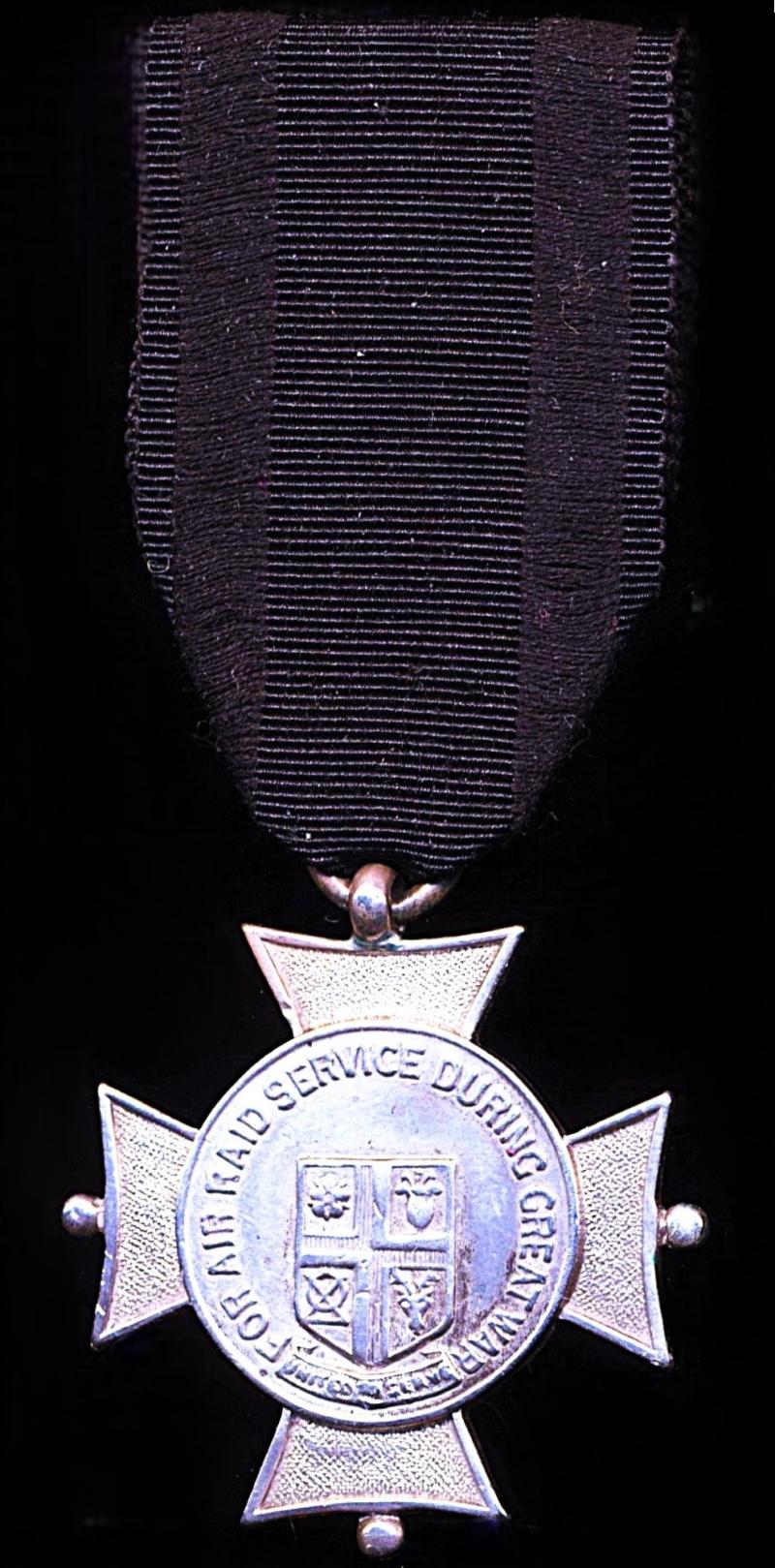
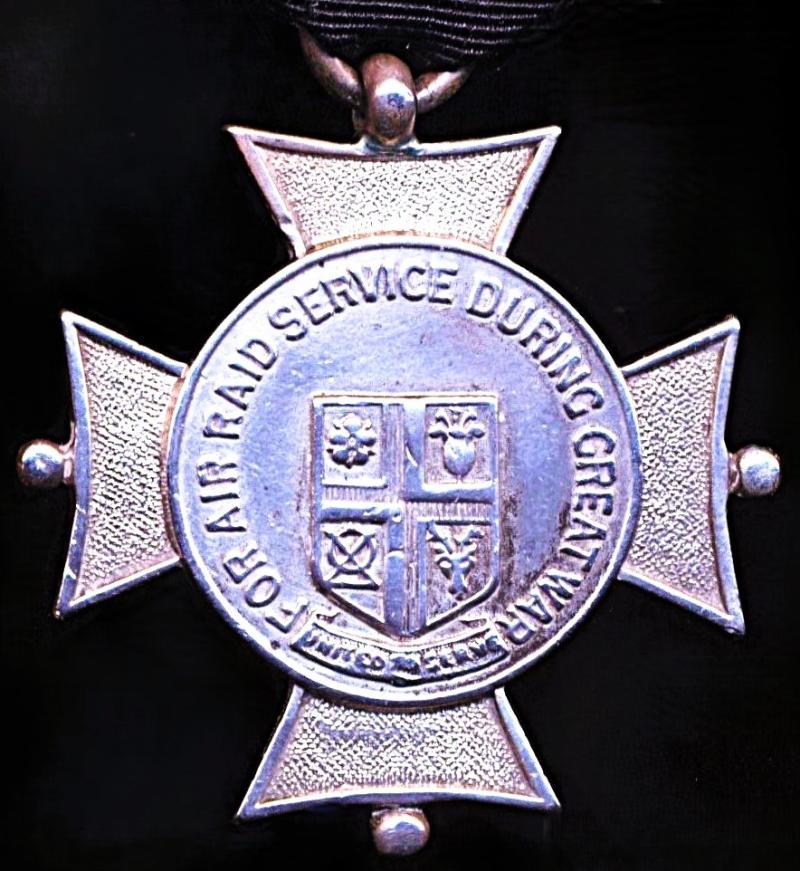
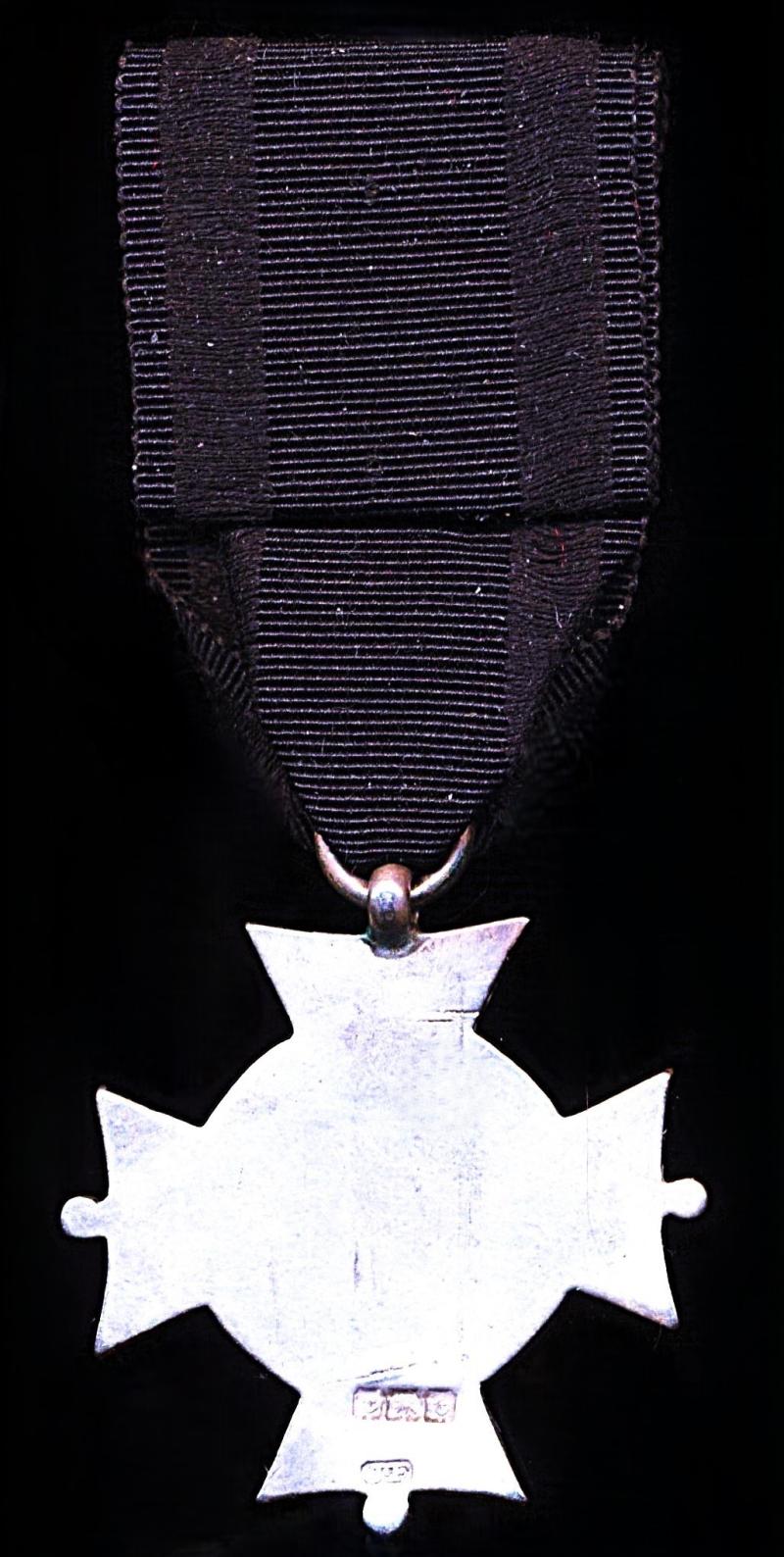
Borough of Southwark (London): Medal For Air Raid Service During Great War. Silver (H/M), for 1918
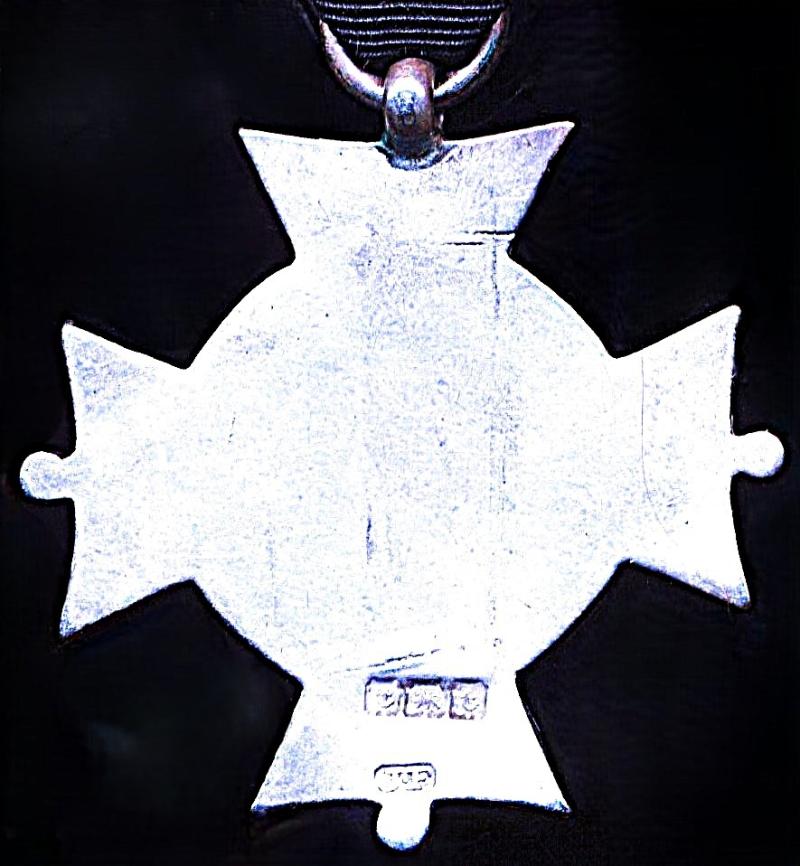
Metal: Silver with Birmingham 1918 hallmark
Dimension: 43mm (H) / mm (W)
Suspension: Fixed ring with a loose hanger ring for attachment to riband
Weight: (including riband)
Maker: Indented on reverse with makers marks 'J.F. for 'James Fenton & Co Birmingham'
Obverse: A four armed Maltese Cross, each arm with a single pommel attached centrally on edge of each arm. In centre a shiled with the 'Arms of the Borough of Southwark', this surrounded by the legend 'For Air Raid Service During Great War' with civic motto below 'United to Serve;
Reverse: Uniface, with indented silver & maker marks
Issuance: Only 91 x medals recorded as presented
Recommendation for the institution of these medals was first tabled by the Ambulance Emergency Committee of the Southwark Borough Council, in 1919, reference 'Islington Gazette' issue of, 7 May 1919:
Quote,
MEDAL FOR RAID WORKERS
In recognition of the services rendered by the volunteer workers in the Southwark district during the air raids, the Ambulance Emergency Committee of the Southwark Borough Council suggest that such workers should be presented with a medal, bearing a suitable inscription, and the coat of arms of the borough, the money to be obtained from grants originally made by the Council for dressings, &c.
Unquote.
Barely two months later, the medals were presented, as reported in the 'Weekly Irish Times' issue of, 2 August 1919:
Quote,
In recognition of services during air raids, the Mayor of Southwark has presented 91 x medals to Volunteers
Unquote.
Awarded in respect of local volunteers who provided air raid precautions, civil defense, or auxiliary support services against German Zepplin bombing raids during the Great War 1914-18
The German Empire conducted a strategic bombing campaign against the United Kingdom throughout the Great War. After some initial attacks by seaplanes, the main campaign began in January 1915 with the use of airships better known as 'Zepplins'. Until the Armistice of 11 November 1918, the Marine-Fliegerabteilung (Navy Aviation Department) and Die Fliegertruppen des deutschen Kaiserreiches (Imperial German Flying Corps) mounted over fifty bombing raids. The raids were generally referred to in Britain as Zeppelin raids. In the autumn of 1916 the Flying Corps abandoned airship raids in favour of bomber aircraft, although the Navy persisted with airships until the end of the war. Although London was the main focus for the raids, many other towns were hit, either as secondary targets or as the result of navigation errors. In all, more than 1,400 people were killed in the raids with almost 3,500 people injured and causing damage amounting to nearly £3 million, for the loss of thirty airships and sixty-two large aeroplanes. Arguably the greatest affect of the Zeppelin raids, was less the physical and materiel losses incurred by the United Kingdom, and more the psychological fear and anxiety endured by much of the population in coastal areas, and large metropolitan areas that lasted the entire length of the Great War
Rare
Condition: GVF
Code: 26316
245.00 GBP